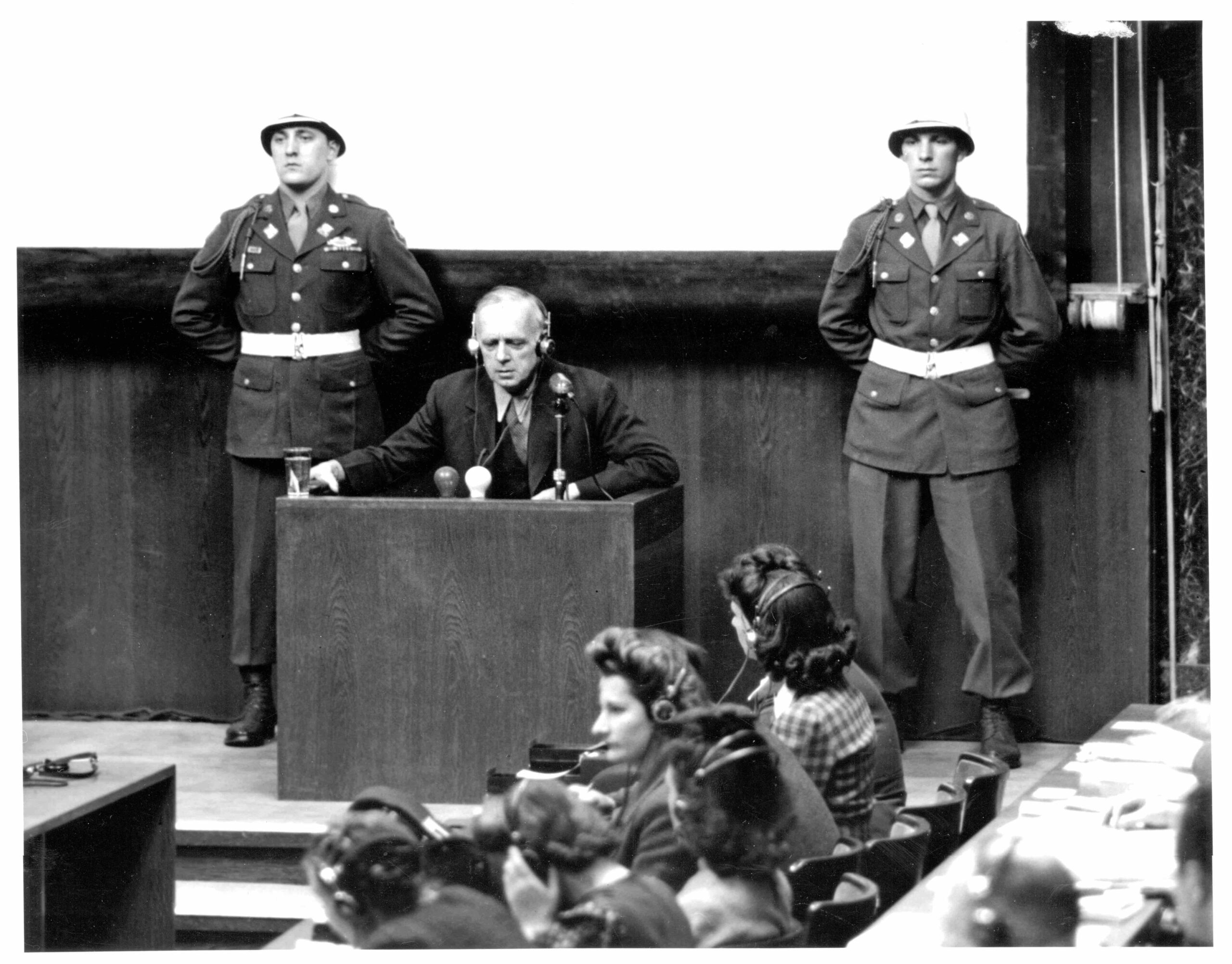
Joachim von Ribbentrop on the witness stand during the International Military Tribunal at Nuremberg, 1945-1946. Joachim von Ribbentrop was Germany's Foreign Minister from 1938-1945. Ribbentrop was charged with crimes against peace, deliberately planning a war of aggression, war crimes and crimes against humanity. Prosecutors presented evidence that Ribbentrop was actively involved in the planning of German aggression and the deportation of Jews to death camps, as well as his advocacy of the killing of American and British airmen shot down over Germany. He was hanged on October 16, 1946.
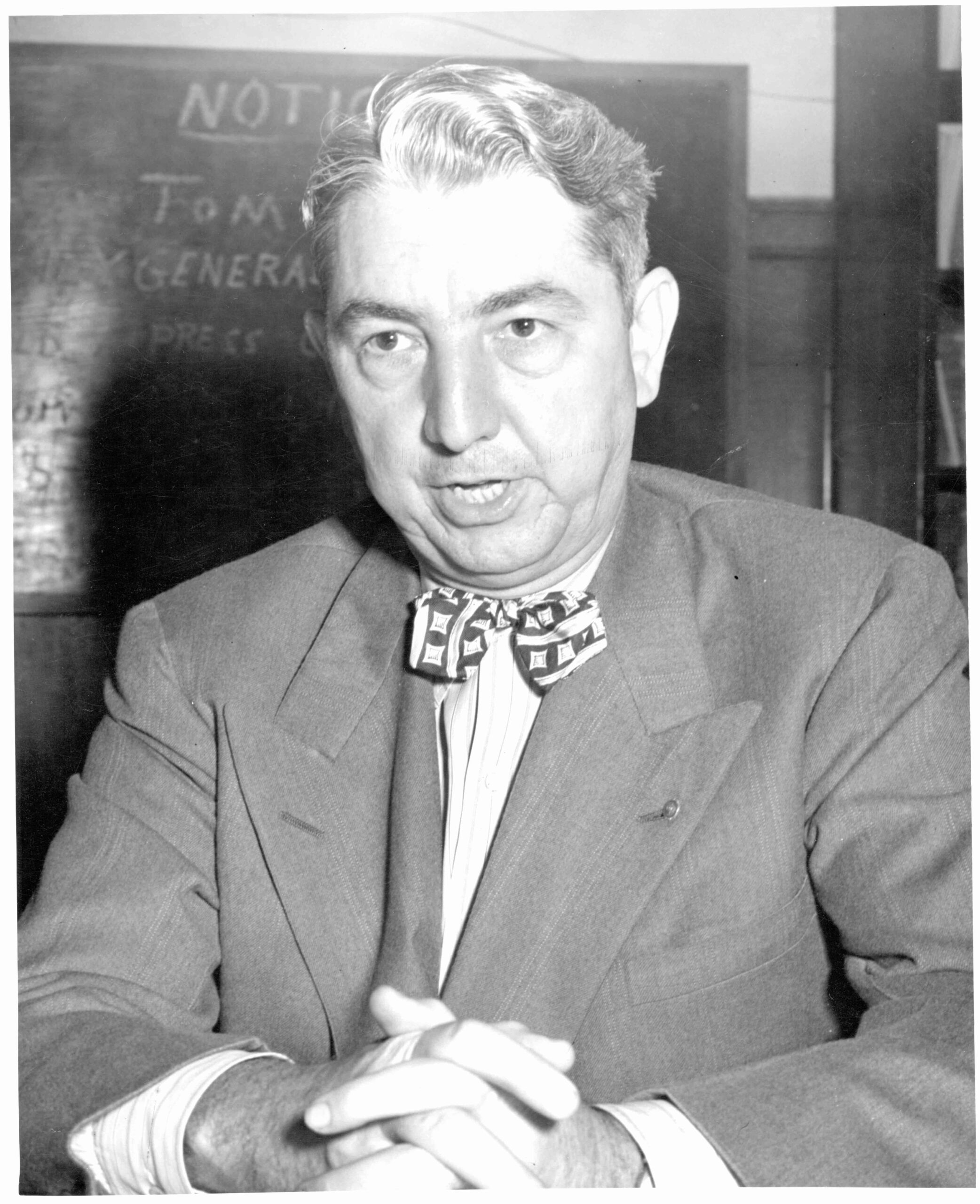
United States Attorney General Tom C. Clark (1945-1949) speaks during a press conference when he attended the International Military Tribunal at Nuremberg. Tom Clark was an Associated Justice of the Supreme Court from 1949-1967.
Dr. Martin Horn (seated outside of defendants dock on left) speaks with Joachim von Ribbentrop (head on hand).
Captain Gustav Gilbert listens to defendant Hans Frank. Other defendants (left to right), Wilhelm Keitel, Ernest Kaltenbrunner, Alfred Rosenberg, and Alfred Jodl.
The defendants wait for the afternoon session to start: (from left to right), Rudolf Hess (standing), Alfred Jodl (standing behind Hess), Alfred Rosenberg (standing next to Hess), Hans Frank (seated), Franz von Papen (seated behind Frank), and Wilhelm Frick (standing facing away from court).
Hjalmar Schacht is released from the court at the end of the trial. Schacht (sitting in center) was a German economist, banker, liberal politician, and co-founder of the German Democratic Party. He became a supporter of Adolf Hitler and the Nazi Party, and served in Hitler's government as President of the Reichsbank and Minister of Economics. Schacht was forced out of the government by disagreements with Hitler and other prominent Nazis by 1936, and had no role during World War II. He became a fringe member of the German Resistance to Hitler and was imprisoned by the Nazis at Dachau. After the war, he was tried at Nuremberg but was acquitted. He is pictured with his counsel, Dr. Gustav Steinbauer (standing with pipe), Dr. Rudolf Dix (sitting next to Schacht) and Professor Dr. Herbert Kraus (in back).
Defendant Hjalmar Schacht on stand at Nuremberg during the IMT, May 1946. Schacht holds a photograph and is wearing the IBM translation headphones.

Internal Revenue Counsel Talks on Taxes
Washington, D.C., - The Senate Finance Committee today (August 6) took up the Roosevelt Tax-on-Wealth Program, and heard from Robert H. Jackson (pictured before committee), Counsel for the Bureau of Internal Revenue.
Mr. Jackson defended proposed higher levies on estates and inheritances, and denounced the validity of the old adage that great wealth is dissipated in three generations. He declared also that the tax system, as of 1930 to 1935 was unsound, and averred that the pending tax program was a move in the direction of reversing the tendency of recent years to place increasing tax burdens on the poorer classes.
Hermann Goering on the witness stand during the noon recess. Goering has a soldier on either side of him.
United States Secretary of War, Robert P. Patterson at Furth airport in Germany.