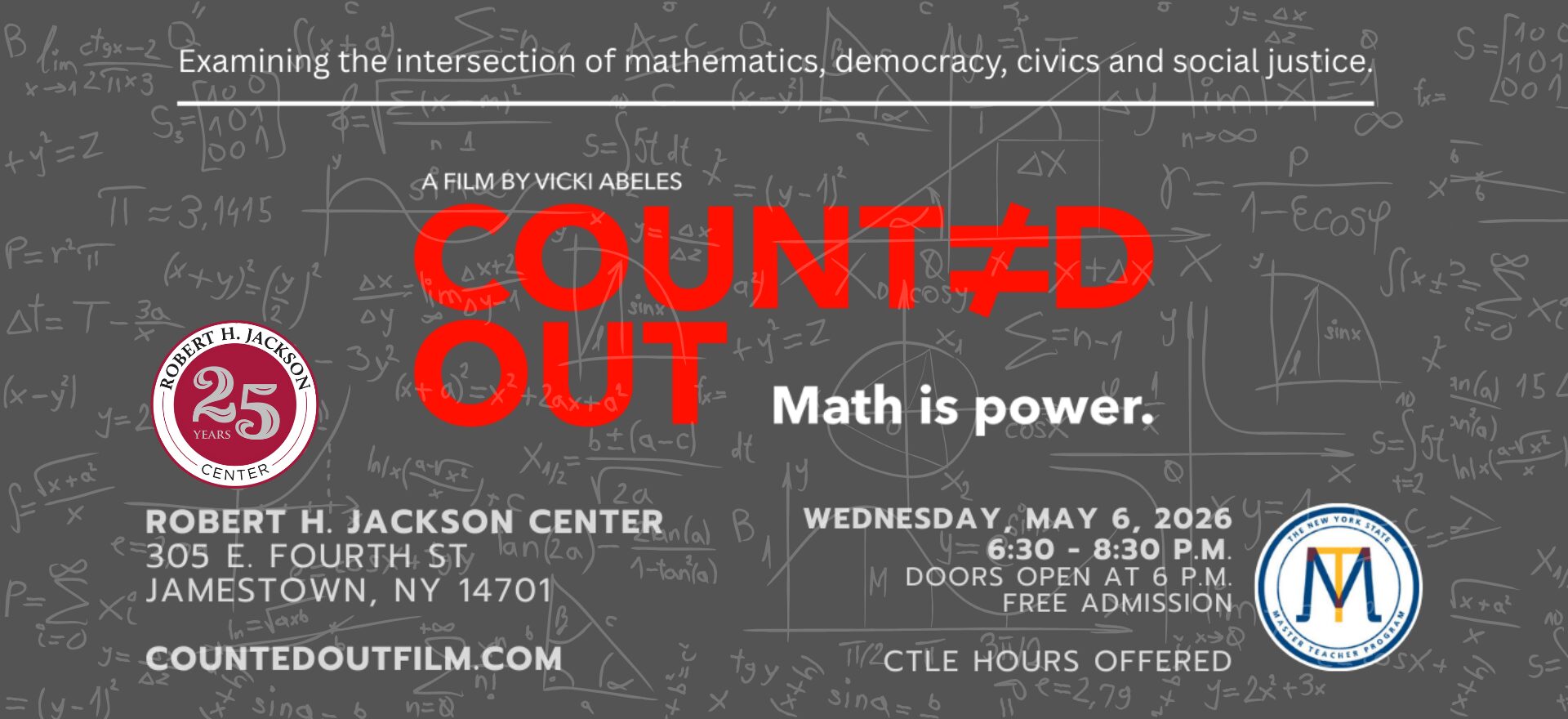
Counted Out investigates the biggest crises of our time through an unexpected lens: math.
In our current information economy, math is everywhere. The people we date, the news we see, the influence of our votes, the candidates who win elections, the education we have access to, the jobs we get—all of it is underwritten by an invisible layer of math that few of us understand, or even notice.
But whether we know it or not, our numeric literacy—whether we can speak the language of math—is a critical determinant of social and economic power.
Through a mosaic of personal stories, expert interviews, and scenes of math transformation in action, Counted Out shows what’s at risk if we keep the status quo. Do we want an America in which most of us don’t consider ourselves “math people”? Where math proficiency goes down as students grow up? Or do we want a country where everyone can understand the math that undergirds our society—and can help shape it?
This screening is presented in partnership with The New York State Master Teacher Program. The conversation after the movie will be led by the co-Regional Director of the NYSMTP, Dr. David C. Wilson and Falconer Central School's Director of Technology and STEM, Mary Plumb.
Dr. Wilson is an associate professor and Graduate program chair at Buffalo State University. He earned his PhD in Mathematics Education in 2002 at SUNY Buffalo under the direction of Douglas H. Clements. His dissertation titled Young Children’s Composition of Shape: A Learning Trajectory, stemmed from work on the NSF-funded project: Building Blocks—Foundations for Mathematical Thinking, Pre-Kindergarten to Grade 2. His teaching background includes more than a decade of teaching high school mathematics with another two+ decades of teaching mathematics and mathematics education courses at the undergraduate and graduate levels. His research focuses on teaching and learning across grades 3-12 within problem-based and Building Thinking Classroom environments. His most recent work as Principal Investigator in the NSF-funded Analyzing Instruction in Mathematics using the TRU framework (AIM-TRU) focused on creating video cases to support teachers in reflecting on and refining their practice in light of the Teaching for Robust Understanding (TRU) framework and the implementation of Formative Assessment Lessons. In addition, he is co-Regional Director of the New York State Master Teacher Program, Western Region (wnymtp.buffalostate.edu), and in that capacity supports K–12 STEM teachers in a range of professional learning activities.
Mary Plumb has over twenty years of experience in public education and currently serves as the Director of Technology and STEM at Falconer Central Schools. She earned her BS in Science in Mathematics from the University of Notre Dame, her MAE in Curriculum and Instruction from Chapman University, and completed her graduate coursework in administration with Stony Brook University. Named a NYS Master Teacher for mathematics in 2015, Ms. Plumb has devoted much of the last decade to improving STEM education. She strives to build communities of practice focused on continuous improvement in teaching and learning, and works to leverage regional resources to support whole-child development.
If you are a teacher and would like to receive CTLE credit for attending this program, please fill out this form.
To register for this event, please fill out this form:
The Robert H. Jackson Center is a non-profit, non-partisan educational organization that is dedicated to presenting accurate and balanced information about complex issues. The opinions expressed by various guest speakers, panelists, and authors do not necessarily reflect the views of the Center, its Board, and supporters.
The Center fulfills its educational mission by welcoming diverse views and by providing a forum to explore a wide range of perspectives on often controversial legal and public policy issues. While we make an effort to ensure the information we provide is accurate and balanced, we welcome your comments, suggestions, or correction of any factual errors.
Since 2001, the Robert H. Jackson Center has preserved the values embodied in the life and works of Robert H. Jackson, who served as U.S. Solicitor General, U.S. Attorney General, U.S. Supreme Court Justice, and Chief U.S. Prosecutor of the International Military Tribunal at Nuremberg. Through programs, presentations, exhibits, media, internships, and scholarship, the Center seeks to demonstrate to current and future generations the relevance and applicability of Justice Jackson’s ideas and writings. The Center provides educational content on the United States Constitution and Supreme Court, civil rights, the legacy of the International Military Tribunal at Nuremberg and international human rights, and the rule of law. During his illustrious career, Justice Jackson addressed these subjects, and the Center recognizes his thinking remains relevant today.