Robert H. Jackson’s journey, from a small-town upbringing in Frewsburg to the Supreme Court and then to Nuremberg, raises enduring questions about leadership, justice, and legacy. Why do we continue to study Jackson today? What makes a life worthy of remembrance? And how does one person’s commitment to principle shape institutions and ideas long after they are gone?
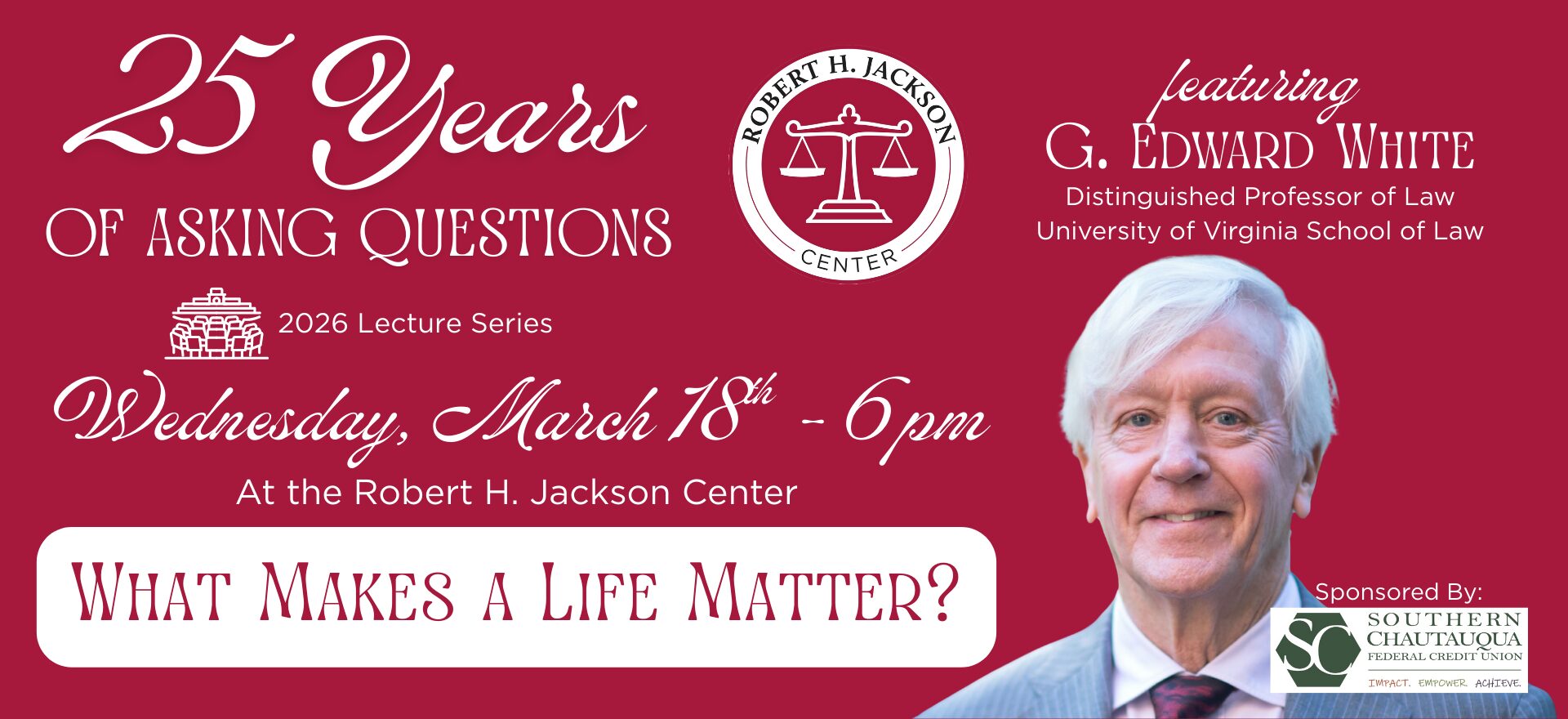
In this program, distinguished legal historian G. Edward White explores these questions through the lens of his acclaimed new biography, Robert H. Jackson: A Life in Judgment. Drawing from Jackson’s personal papers, oral histories, and decades of scholarship, White presents a portrait of the justice who defended New Deal policies, authored landmark opinions such as Barnette, dissented in Korematsu, and served as chief U.S. prosecutor at Nuremberg.
This lecture is part of our 25 Years of Asking Questions lecture series. We are thankful to the Southern Chautauqua Federal Credit Union for sponsoring this series. Southern Chautauqua Federal Credit Union, supporting individuals and organizations who also impact, empower, and achieve within our community.
G. Edward White is the David and Mary Harrison Distinguished Professor of Law at the University of Virginia School of Law and one of the nation’s most respected scholars of American legal history. A former clerk to Chief Justice Earl Warren, White has authored 20 books, received numerous national awards, including honors from the American Historical Association, the ABA, and the AALS, and is a fellow of both the American Academy of Arts & Sciences and the Society of American Historians. His scholarship ranges from constitutional law to the cultural history of American sports, and he has delivered major endowed lectures across the country and abroad.
His new book, Robert H. Jackson: A Life in Judgment, traces Jackson’s extraordinary rise from self-taught country lawyer to Supreme Court justice and chief prosecutor at Nuremberg. It offers fresh insight into Jackson’s independent judicial philosophy, his defense of civil liberties, and the global impact of his work at the International Military Tribunal.
The book will be available for purchase at the program.
The Robert H. Jackson Center is a non-profit, non-partisan educational organization that is dedicated to presenting accurate and balanced information about complex issues. The opinions expressed by various guest speakers, panelists, and authors do not necessarily reflect the views of the Center, its Board, and supporters.
The Center fulfills its educational mission by welcoming diverse views and by providing a forum to explore a wide range of perspectives on often controversial legal and public policy issues. While we make an effort to ensure the information we provide is accurate and balanced, we welcome your comments, suggestions, or correction of any factual errors.
Since 2001, the Robert H. Jackson Center has preserved the values embodied in the life and works of Robert H. Jackson, who served as U.S. Solicitor General, U.S. Attorney General, U.S. Supreme Court Justice, and Chief U.S. Prosecutor of the International Military Tribunal at Nuremberg. Through programs, presentations, exhibits, media, internships, and scholarship, the Center seeks to demonstrate to current and future generations the relevance and applicability of Justice Jackson’s ideas and writings. The Center provides educational content on the United States Constitution and Supreme Court, civil rights, the legacy of the International Military Tribunal at Nuremberg and international human rights, and the rule of law. During his illustrious career, Justice Jackson addressed these subjects, and the Center recognizes his thinking remains relevant today.