This event will be in-person at the Jackson Center.
From internet misinformation and campus protests to hate speech and extremist rallies, questions about the limits of free expression have become some of the most pressing issues of our time. This program invites attendees to examine not only what the First Amendment protects, but also what responsibilities come with that freedom. Through this conversation, we aim to provide historical, legal, and civic context that helps the public better understand how free speech shapes our democracy, and how we can navigate the challenges of truth, safety, and open discourse in a rapidly changing world.
This conversation is grounded in the legacy of Robert H. Jackson, who wrote in West Virginia State Board of Education v. Barnette, 319 U.S. 624 (1943) that “freedom to differ is not limited to things that do not matter much.” Jackson’s words remind us that the right to speak, dissent, and challenge authority lies at the heart of democratic life, a principle that remains as vital and contested today as it was in his time.
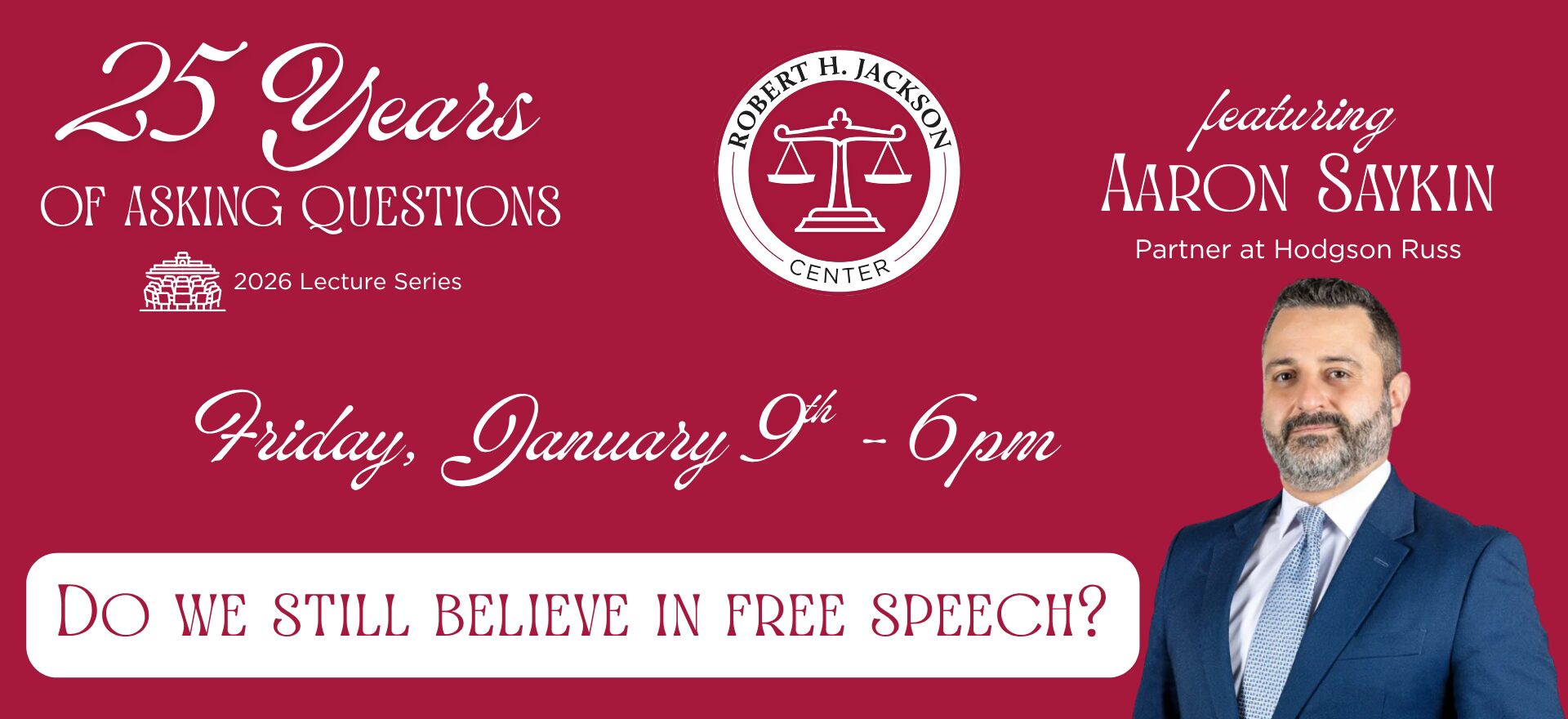
Our featured speaker, Aaron Saykin, leads the Media and First Amendment Practice at Hodgson Russ LLP in Buffalo, where he advises clients on defamation, free speech, and access-to-information issues under New York’s Open Meetings and Freedom of Information Laws. Drawing on his 13 years as an investigative television reporter in Pittsburgh, Buffalo, and Wilmington, North Carolina, Aaron brings a unique perspective to the intersection of law, media, and public accountability.
He has become a trusted advisor to higher education institutions and other organizations navigating the challenges of free expression, reputation management, and media relations. Aaron's work reflects a deep commitment to protecting the principles of transparency and the First Amendment in modern civic life.
The Robert H. Jackson Center is a non-profit, non-partisan educational organization that is dedicated to presenting accurate and balanced information about complex issues. The opinions expressed by various guest speakers, panelists, and authors do not necessarily reflect the views of the Center, its Board, and supporters.
The Center fulfills its educational mission by welcoming diverse views and by providing a forum to explore a wide range of perspectives on often controversial legal and public policy issues. While we make an effort to ensure the information we provide is accurate and balanced, we welcome your comments, suggestions, or correction of any factual errors.
Since 2001, the Robert H. Jackson Center has preserved the values embodied in the life and works of Robert H. Jackson, who served as U.S. Solicitor General, U.S. Attorney General, U.S. Supreme Court Justice, and Chief U.S. Prosecutor of the International Military Tribunal at Nuremberg. Through programs, presentations, exhibits, media, internships, and scholarship, the Center seeks to demonstrate to current and future generations the relevance and applicability of Justice Jackson’s ideas and writings. The Center provides educational content on the United States Constitution and Supreme Court, civil rights, the legacy of the International Military Tribunal at Nuremberg and international human rights, and the rule of law. During his illustrious career, Justice Jackson addressed these subjects, and the Center recognizes his thinking remains relevant today.