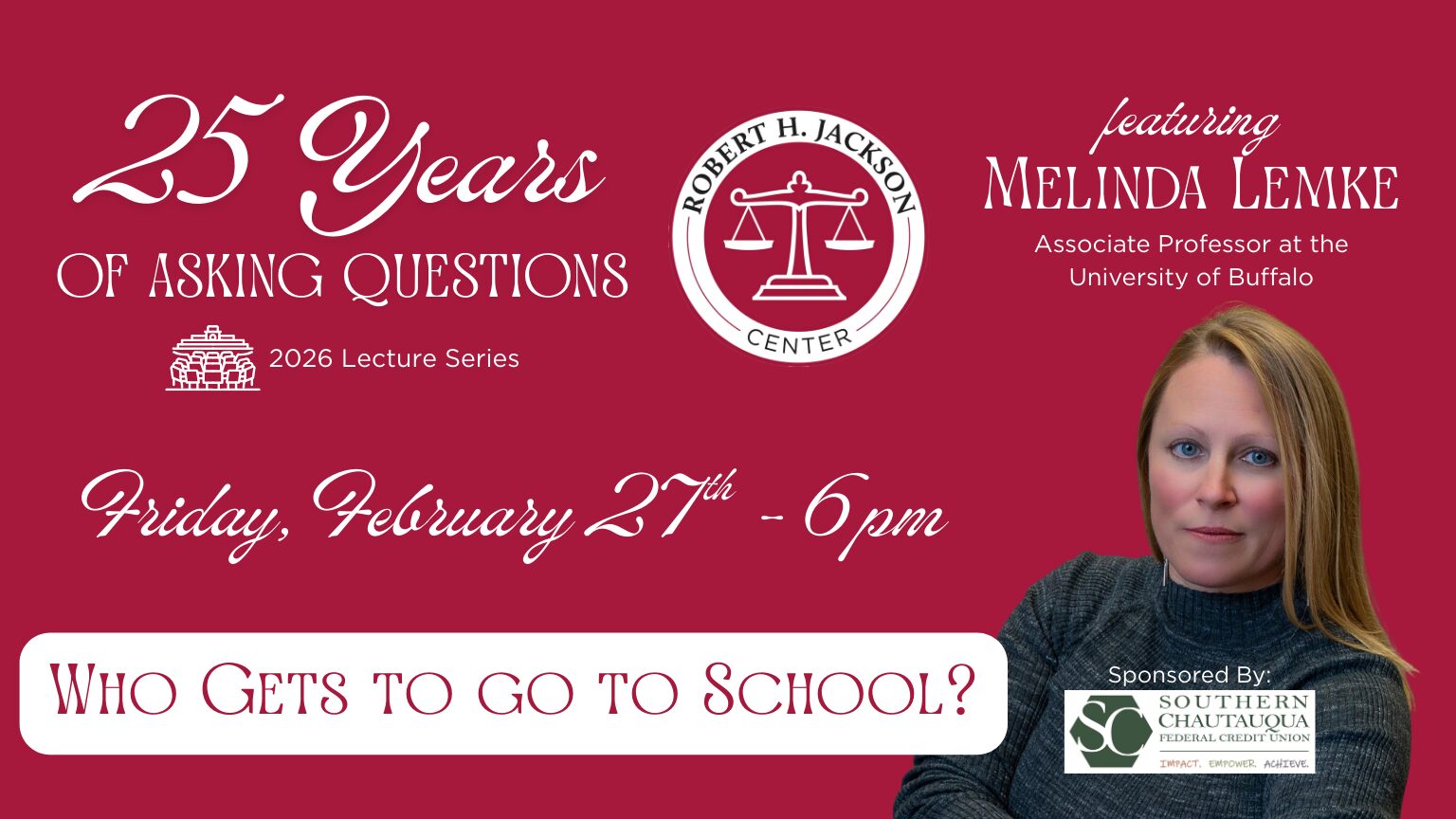
From school segregation and busing to book bans, charter schools, and modern achievement gaps, the fight for educational equity has long reflected the nation’s broader struggle to live up to its democratic ideals. In her lecture, The Politics of U.S. Public Schooling: Tinkering Toward and Away from Dystopia, Dr. Melinda Lemke invites attendees to examine how far we’ve come since Brown v. Board of Education, and what still divides us. Through this conversation, we aim to explore the legal, cultural, and policy battles that have shaped access to education in America, and to encourage reflection on what “equal education” should mean in the 21st century.
The discussion is grounded in the legacy of Robert H. Jackson’s final Supreme Court case, Brown v. Board of Education, 347 U.S. 483 (1954), the landmark decision that declared segregation in public schools unconstitutional. The ruling affirmed that equality in education is essential to equality in citizenship, an idea that continues to challenge our laws, institutions, and collective conscience.
This lecture is part of our 25 Years of Asking Questions lecture series. We are thankful to the Southern Chautauqua Federal Credit Union for sponsoring this series. Southern Chautauqua Federal Credit Union, supporting individuals and organizations who also impact, empower, and achieve within our community.
Melinda Lemke, Ph.D., is an Associate Professor of Educational Policy and affiliated faculty in Global Gender and Sexuality Studies at the University
at Buffalo (UB), SUNY. Dr. Lemke is a qualitative methodologist, and her research focuses on the politics of education and how social policies address structural violence to improve the health, well-being, and human rights of women and girls. This includes examining the causes, effects, discourses concerning, and public system responses to gender-based violence and the largescale internal and cross-border displacement.
Dr. Lemke’s work in higher education is informed by a previous career in U.S. public secondary education and work in sexual assault prevention and advocacy. She is actively involved in shared governance at UB, SUNY, serving for example as faculty senator elect and as United University Professionals Buffalo Center Chapter Grievance Officer for Academics. Dr. Lemke is the author of more than 60 publications and is the recipient of multiple research and practice awards, including most recently the Paula Silver Case Award for co-authored research on human trafficking and the Dr. Conrad F. Toepfer, Jr. Award for doctoral mentorship.
The Robert H. Jackson Center is a non-profit, non-partisan educational organization that is dedicated to presenting accurate and balanced information about complex issues. The opinions expressed by various guest speakers, panelists, and authors do not necessarily reflect the views of the Center, its Board, and supporters.
The Center fulfills its educational mission by welcoming diverse views and by providing a forum to explore a wide range of perspectives on often controversial legal and public policy issues. While we make an effort to ensure the information we provide is accurate and balanced, we welcome your comments, suggestions, or correction of any factual errors.
Since 2001, the Robert H. Jackson Center has preserved the values embodied in the life and works of Robert H. Jackson, who served as U.S. Solicitor General, U.S. Attorney General, U.S. Supreme Court Justice, and Chief U.S. Prosecutor of the International Military Tribunal at Nuremberg. Through programs, presentations, exhibits, media, internships, and scholarship, the Center seeks to demonstrate to current and future generations the relevance and applicability of Justice Jackson’s ideas and writings. The Center provides educational content on the United States Constitution and Supreme Court, civil rights, the legacy of the International Military Tribunal at Nuremberg and international human rights, and the rule of law. During his illustrious career, Justice Jackson addressed these subjects, and the Center recognizes his thinking remains relevant today.