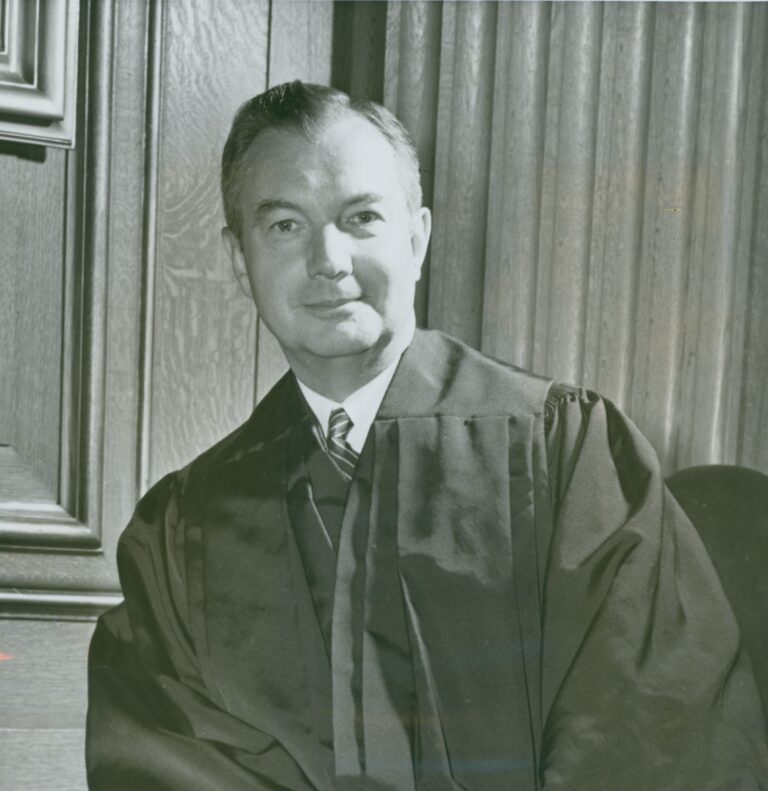
On June 12, 1941, President Franklin D. Roosevelt nominated Robert H. Jackson to the Supreme Court of the United States. He filled the vacancy created by Harlan Fiske Stone’s elevation to Chief Justice following the retirement of Charles Evans Hughes. The Senate confirmed Jackson’s appointment on July 7, and he took the judicial oath on July 11, 1941.
As an Associate Justice, Jackson became known for his independent, pragmatic reasoning, eloquent writing, and unwavering belief that law must serve liberty, and that liberty must be protected from power, even when that power claims noble intent. A defender of individual rights, Jackson’s opinions continue to shape constitutional law.
One of his most celebrated opinions came in West Virginia State Board of Education v. Barnette (1943), where the Court struck down a mandatory flag salute in public schools. Jackson’s powerful defense of freedom of speech and conscience has become one of the most quoted passages in First Amendment jurisprudence.
Jackson’s fiery dissent in Korematsu v. United States (1944) remains a warning against sacrificing civil liberties in the name of national security. He cautioned that validating the exclusion of Japanese Americans during wartime set a dangerous precedent for legalized racial discrimination.
His concurring opinion in Youngstown Sheet & Tube Co. v. Sawyer (1952), often referred to as the "Jackson framework," continues to guide courts and legal scholars in evaluating the limits of presidential power. Nearly every modern Supreme Court nominee has used Jackson’s reasoning in this landmark case during their confirmation hearings.