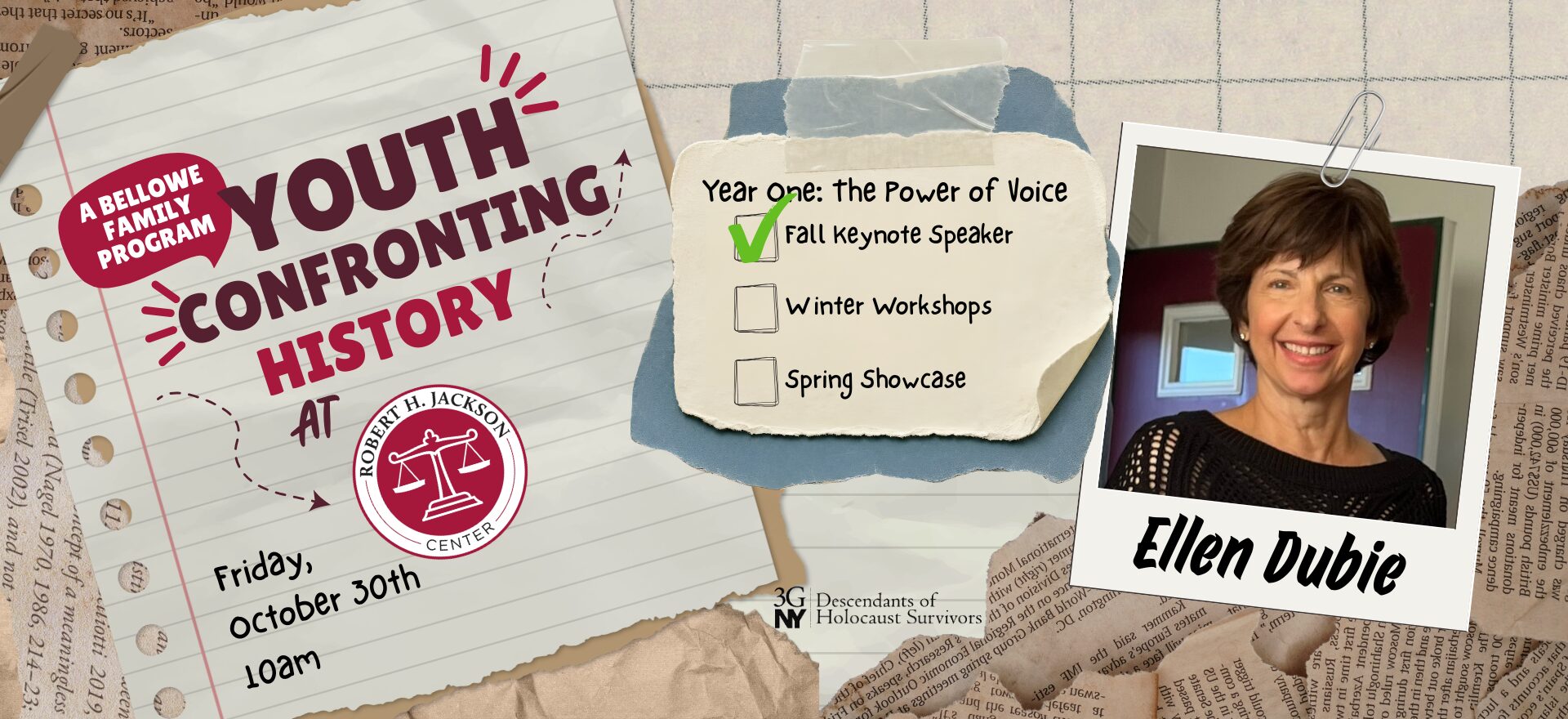
Youth Confronting History engages middle and high school students in Western New York, Northwestern Pennsylvania, and the surrounding region in an in-depth exploration of justice, moral courage, and civic responsibility. Over three years, students will examine the Holocaust and the Nuremberg Trials through the themes of voice, justice, and action. The goal is to connect historical events to the choices young people face today.
This program is generously funded by the Arnold and Jill Bellowe Family Foundation which means students and teachers have no cost to participate.
More information about the Youth Confronting History program and registration can be found here.
The fall keynote is open to all middle and high school students and participation in the full Youth Confronting History program is not required to attend. However, we strongly encourage teachers to register their students for the full program and participate in the workshops and spring Student Showcase. The keynote is designed to serve as the opening experience for the year, with the winter workshops and spring showcase providing opportunities for students to explore the topic more deeply and put their learning into action. You are welcome to bring your students to the keynote on its own, but we encourage you to take advantage of the full Youth Confronting History experience!
Ellen Dubie is a second-generation Holocaust survivor, born in Boston, MA, and moved to Buffalo 9 years ago and was a former HRC Board member. Her father, Stephan H. Lewy (1925-2021), was a Holocaust Survivor, who was an active speaker in Massachusetts, New Hampshire, and Western NY for several years. Ellen is the Program Administrator of the Internal Medicine-Pediatrics Residency Program at the University at Buffalo.
Stephan Lewy was born Heinz Stephan Lewy in Berlin in 1925. Stephan grew up in the Auerbach Orphanage where he lived through Kristallnacht hiding in the orphanage’s synagogue. Stephan was then sent on a Kindertransport to France in 1939, living in both occupied and unoccupied zones. In 1942, Stephan was able to get passage to the United States and in 1943 he was drafted into the U.S. Army. After the war Stephan returned to the U.S..
The Robert H. Jackson Center is a non-profit, non-partisan educational organization that is dedicated to presenting accurate and balanced information about complex issues. The opinions expressed by various guest speakers, panelists, and authors do not necessarily reflect the views of the Center, its Board, and supporters.
The Center fulfills its educational mission by welcoming diverse views and by providing a forum to explore a wide range of perspectives on often controversial legal and public policy issues. While we make an effort to ensure the information we provide is accurate and balanced, we welcome your comments, suggestions, or correction of any factual errors.
Since 2001, the Robert H. Jackson Center has preserved the values embodied in the life and works of Robert H. Jackson, who served as U.S. Solicitor General, U.S. Attorney General, U.S. Supreme Court Justice, and Chief U.S. Prosecutor of the International Military Tribunal at Nuremberg. Through programs, presentations, exhibits, media, internships, and scholarship, the Center seeks to demonstrate to current and future generations the relevance and applicability of Justice Jackson’s ideas and writings. The Center provides educational content on the United States Constitution and Supreme Court, civil rights, the legacy of the International Military Tribunal at Nuremberg and international human rights, and the rule of law. During his illustrious career, Justice Jackson addressed these subjects, and the Center recognizes his thinking remains relevant today.