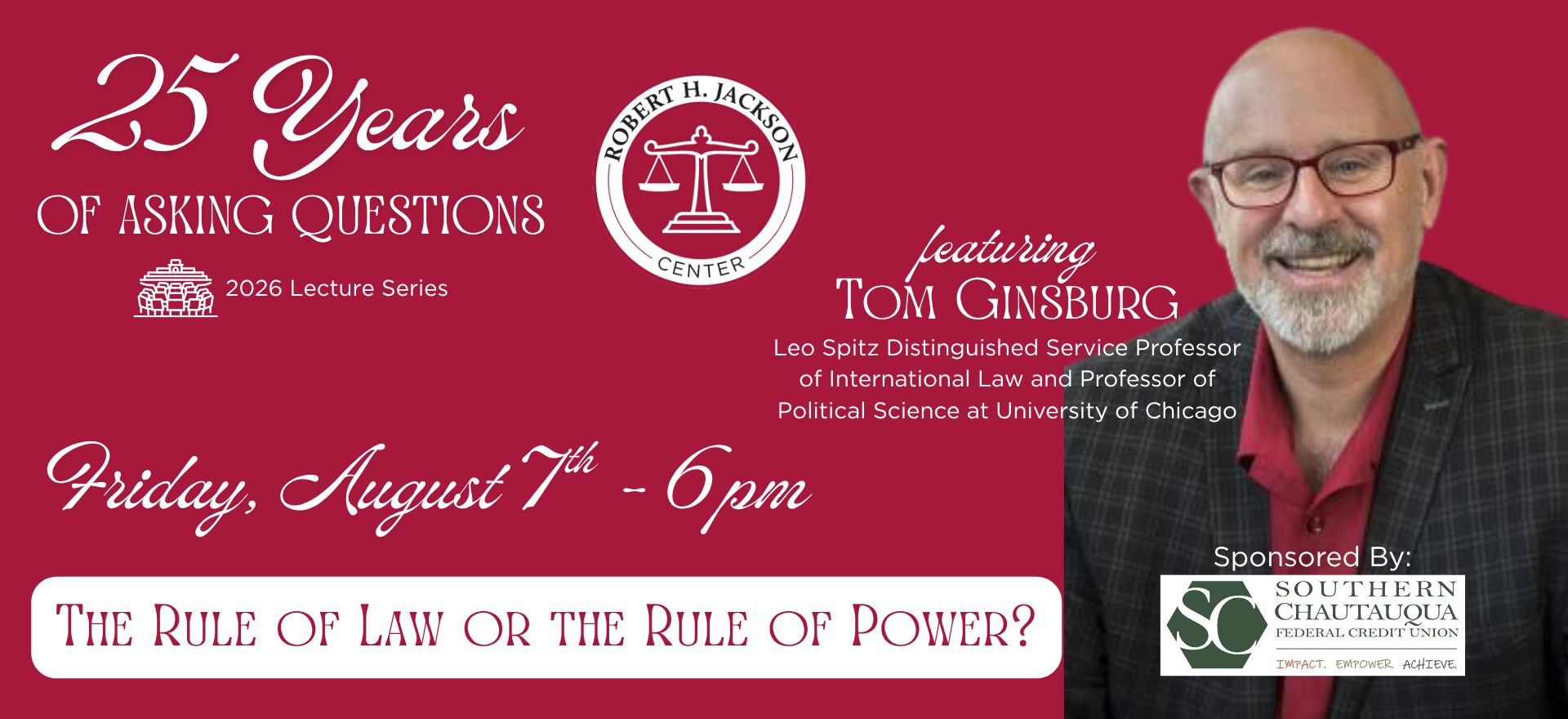
Drawing on Robert H. Jackson’s pivotal role in confronting fascism and shaping international justice, this lecture explores how legal integrity sustains democracy, public trust, and freedom. From unchecked power to authoritarianism, the program examines why the rule of law is fragile in times of crisis, and what protects society when it is challenged.
Tom Ginsburg is the Leo Spitz Distinguished Service Professor of International Law at the University of Chicago, Faculty Director of the Malyi Center for the Study of Institutional and Legal Integrity, and Faculty Director of the Forum for Free Inquiry and Expression. He focuses on comparative and international law from an interdisciplinary perspective, and has authored award-winning books including Democracies and International Law (2021) and How to Save a Constitutional Democracy (2018, with Aziz Z. Huq).
A leading scholar on constitutional durability and judicial institutions, Professor Ginsburg co-directs the Comparative Constitutions Project and has served as a legal adviser at the Iran-US Claims Tribunal and The Hague. He is a member of the American Academy of Arts and Sciences and co-hosts the podcast Entitled, which explores human rights around the world.
The Robert H. Jackson Center is a non-profit, non-partisan educational organization that is dedicated to presenting accurate and balanced information about complex issues. The opinions expressed by various guest speakers, panelists, and authors do not necessarily reflect the views of the Center, its Board, and supporters.
The Center fulfills its educational mission by welcoming diverse views and by providing a forum to explore a wide range of perspectives on often controversial legal and public policy issues. While we make an effort to ensure the information we provide is accurate and balanced, we welcome your comments, suggestions, or correction of any factual errors.
Since 2001, the Robert H. Jackson Center has preserved the values embodied in the life and works of Robert H. Jackson, who served as U.S. Solicitor General, U.S. Attorney General, U.S. Supreme Court Justice, and Chief U.S. Prosecutor of the International Military Tribunal at Nuremberg. Through programs, presentations, exhibits, media, internships, and scholarship, the Center seeks to demonstrate to current and future generations the relevance and applicability of Justice Jackson’s ideas and writings. The Center provides educational content on the United States Constitution and Supreme Court, civil rights, the legacy of the International Military Tribunal at Nuremberg and international human rights, and the rule of law. During his illustrious career, Justice Jackson addressed these subjects, and the Center recognizes his thinking remains relevant today.