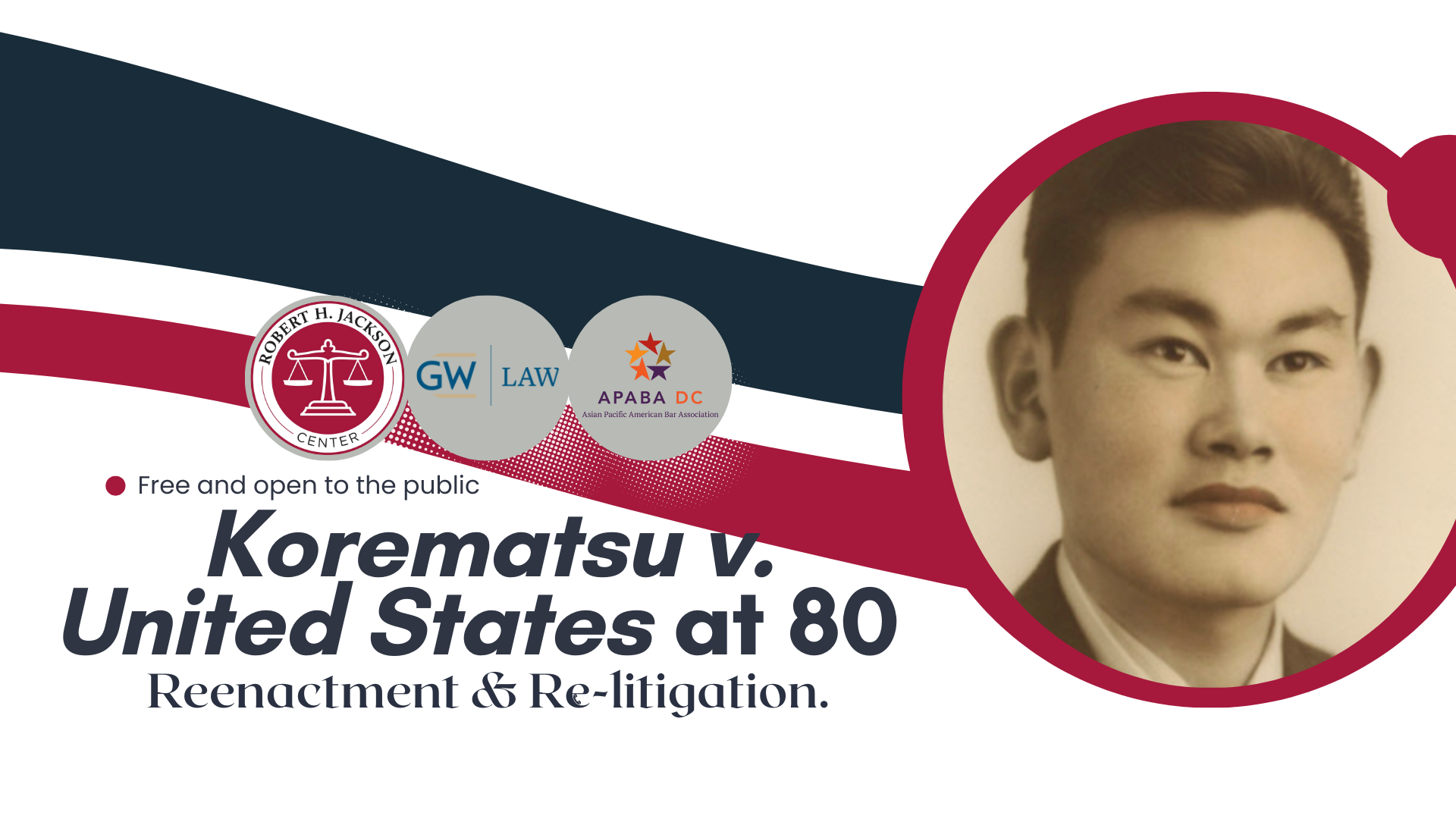
The Robert H. Jackson Center and George Washington University School of Law present two mock oral arguments featuring leading judges and lawyers: a reenactment of October 1944 U.S. Supreme Court oral arguments in the Korematsu case, and a mock civil case being litigated today by a “Fred Korematsu” who is subjected to an order to leave his home and report to a location from which he will be sent to a detention center.
In Korematsu (1944), the Supreme Court affirmed the constitutionality of Mr. Korematsu’s criminal conviction for violating the 1942 U.S. military order excluding Japanese-Americans from the West Coast.
Registration is required (click here!) and a limited-availability reception will follow the event. Please email publicinterest@law.gwu.edu or call 202.994.2680 with any questions or concerns.
The Robert H. Jackson Center is a non-profit, non-partisan educational organization that is dedicated to presenting accurate and balanced information about complex issues. The opinions expressed by various guest speakers, panelists, and authors do not necessarily reflect the views of the Center, its Board, and supporters.
The Center fulfills its educational mission by welcoming diverse views and by providing a forum to explore a wide range of perspectives on often controversial legal and public policy issues. While we make an effort to ensure the information we provide is accurate and balanced, we welcome your comments, suggestions, or correction of any factual errors.
Since 2001, the Robert H. Jackson Center has preserved the values embodied in the life and works of Robert H. Jackson, who served as U.S. Solicitor General, U.S. Attorney General, U.S. Supreme Court Justice, and Chief U.S. Prosecutor of the International Military Tribunal at Nuremberg. Through programs, presentations, exhibits, media, internships, and scholarship, the Center seeks to demonstrate to current and future generations the relevance and applicability of Justice Jackson’s ideas and writings. The Center provides educational content on the United States Constitution and Supreme Court, civil rights, the legacy of the International Military Tribunal at Nuremberg and international human rights, and the rule of law. During his illustrious career, Justice Jackson addressed these subjects, and the Center recognizes his thinking remains relevant today.