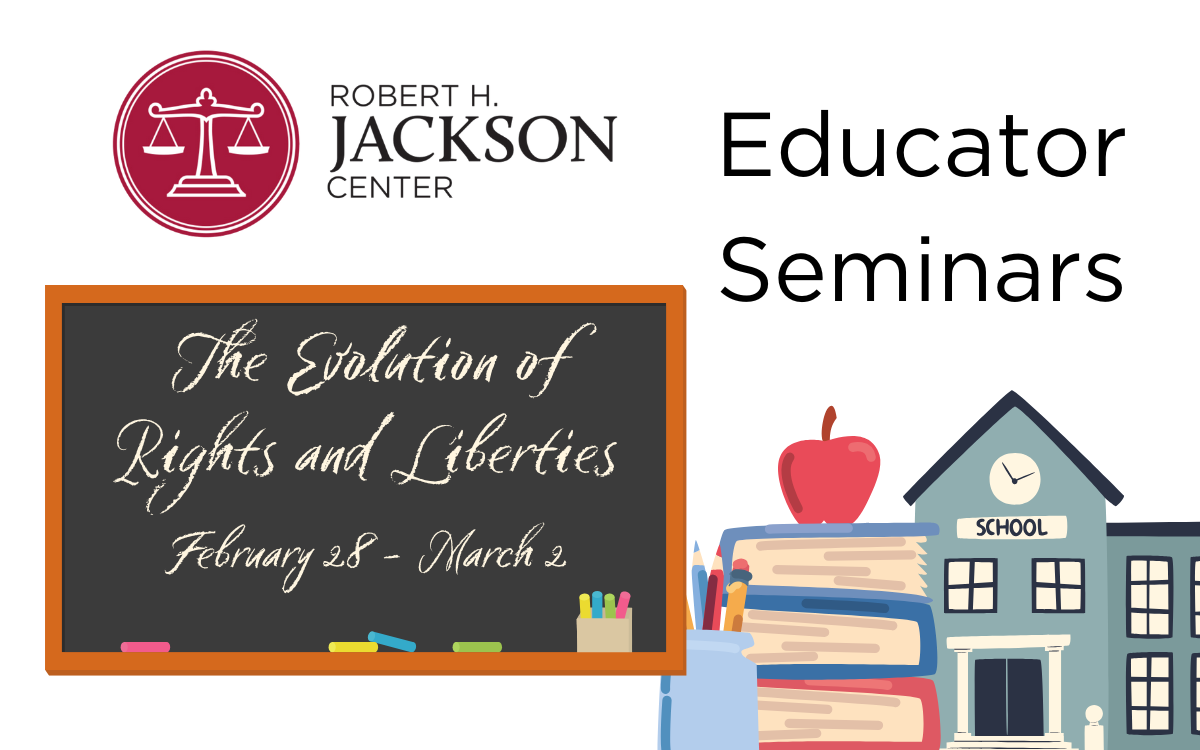
Join us for a unique opportunity to explore the evolution of civil rights and liberties through the lens of Robert H. Jackson’s legacy. This seminar is designed for educators to deepen their understanding of the historical foundations of justice, accountability, and human rights, while equipping them with practical tools to teach these critical concepts in their classrooms.
Through interactive lectures, case studies, and dynamic discussions, participants will examine key moments from Jackson’s work as a Supreme Court Justice and as Chief Prosecutor at the Nuremberg Trials.
By the end of the seminar, you’ll walk away with new insights, teaching strategies, and a deeper understanding of how to foster critical thinking and civil discourse in your classroom. Participants will also receive 10 hours of CTLE credits for participating in the full seminar (while we are pending NYS approval as a CTLE-sponsored site, this program is being sponsored by the Niagara Frontier Council for the Social Studies (NFCSS)).
You can Register Here.
Learning Objectives:
Alignment with State Standards:
Scholars:
Schedule (Meals are Included):
Day 1: Friday, February 28th, 2025: Arrival, Check-In, and Welcome Reception (Optional for Participants)
3:30pm to 7:00pm Check-in at Robert H Jackson Center
4:30pm to 5:00pm Welcome, Agenda Overview
5:00pm to 6:00pm Reception and Free time to explore the Center
6:00pm to 7:00pm Welcome Dinner
7:00pm to 7:30pm Welcome and Introduction to Jackson’s Legacy
Day 2: Saturday, March 1st, 2025: Bulk of Programming
8:00am to 8:45am Breakfast and Check-In
8:45am to 9:15am Preview Session
9:15am to 12:00pm Jackson’s Rise to the Court and Early Cases
This session will cover the different methods Justices reach the bench, including Jackson’s unique rise. This will also set the stage for the world in which Jackson was entering the Supreme Court. Then the scholars will focus on early cases that shaped Jackson’s legacy. With a rise in persecution towards Jehovah’s Witnesses, one of Jackson’s pivotal cases took place early in his career when he wrote the majority opinion in West Virginia State Board of Education v. Barnette (1943), reversing the Court’s earlier decision in Minersville School District v. Gobitis (1940). The scholars will also explore the ideas of Incorporation Doctrine, the clear and present danger test, and compelled speech through other cases such as Jones v. Opelika (1942) and Dennis v. United States (1951).
12:00pm to 1:00pm Lunch
1:00pm to 5:00pm Civil Liberties and Rights during Wartime and Nuremberg
This session will look back at the initial Red Scare cases during WWI such as Schenck v. United States (1919) and Abrams v. United States (1919) and use them to look at what national security concerns existed during such a conflict. They will then move into the national security concerns that existed after Pearl Harbor and the issuance of Executive Order 9066 which eventually led to Korematsu v. United States (1944). The scholars will focus on Jackson’s famous dissent from that case and what it means in today’s landscape with recent cases like Trump v. Hawaii (2018). Next, the scholars will focus on Jackson’s role as WWII ended and he was asked to step into a new position as Chief Prosecutor for the United States against Nazi war criminals. Jackson was instrumental in shaping The London Agreement & Charter (August 8, 1945) which, along with Jackson’s powerful opening statement at Nuremberg, introduced new legal concepts and called for the establishment of an international court system that pushed for human rights. Finally, the scholars will wrap this packed session with a discussion of what it meant for Jackson to miss time on the Supreme Court while he was in Nuremberg. They will look at the dynamics of the Court and how it changed after he returned.
5:00pm to 5:30pm End-of-Day Wrap Up
5:30pm to 6:30pm Dinner
Day 3: Sunday, March 2nd, 2025: Finish Program and Departure
8:00am to 8:45am Breakfast
8:45am to 9:15am Review and Preview Session
9:15am to 12:00pm Jackson’s Last Years on the Court
This session will look to Post-War America and examine what restraints the second Red Scare began to have on Civil Liberties and Civil Rights. Scholars will have participants examine cases such as Terminiello v. Chicago (1949) and Beauharnais v. Illinois (1952). They will then move on to Jackson’s famous concurrence in Youngstown Sheet & Tube Co. v. Sawyer (1952) to explain Jackson’s influential voice when it comes to the powers of the President. Last, they will move into the final chapter of Jackson’s time on the Court – his role in Brown v. Board of Education of Topeka (1954). They will discuss the push from Chief Justice Earl Warren to make the decision unanimous and the difficult road to accomplish that as well as the impact of the case.
12:00pm to 12:30pm End-of-Day Wrap Up
12:30pm to 1:30pm Farewell Lunch (Optional for participants)
Register:
We have a maximum of 24 slots available for this seminar, after those spaces are full, we will start a waiting list. You can Register Here. If you are interested in attending, please register by Wednesday, February 26 to secure your spot. When we get closer to the Seminar, those registered will receive more information.
The Robert H. Jackson Center is a non-profit, non-partisan educational organization that is dedicated to presenting accurate and balanced information about complex issues. The opinions expressed by various guest speakers, panelists, and authors do not necessarily reflect the views of the Center, its Board, and supporters.
The Center fulfills its educational mission by welcoming diverse views and by providing a forum to explore a wide range of perspectives on often controversial legal and public policy issues. While we make an effort to ensure the information we provide is accurate and balanced, we welcome your comments, suggestions, or correction of any factual errors.
Since 2001, the Robert H. Jackson Center has preserved the values embodied in the life and works of Robert H. Jackson, who served as U.S. Solicitor General, U.S. Attorney General, U.S. Supreme Court Justice, and Chief U.S. Prosecutor of the International Military Tribunal at Nuremberg. Through programs, presentations, exhibits, media, internships, and scholarship, the Center seeks to demonstrate to current and future generations the relevance and applicability of Justice Jackson’s ideas and writings. The Center provides educational content on the United States Constitution and Supreme Court, civil rights, the legacy of the International Military Tribunal at Nuremberg and international human rights, and the rule of law. During his illustrious career, Justice Jackson addressed these subjects, and the Center recognizes his thinking remains relevant today.