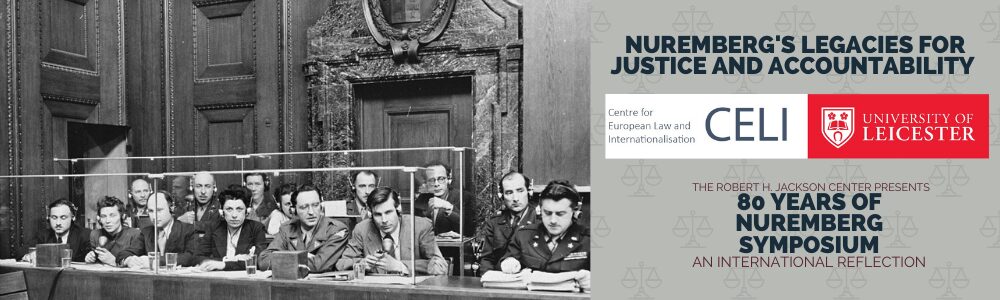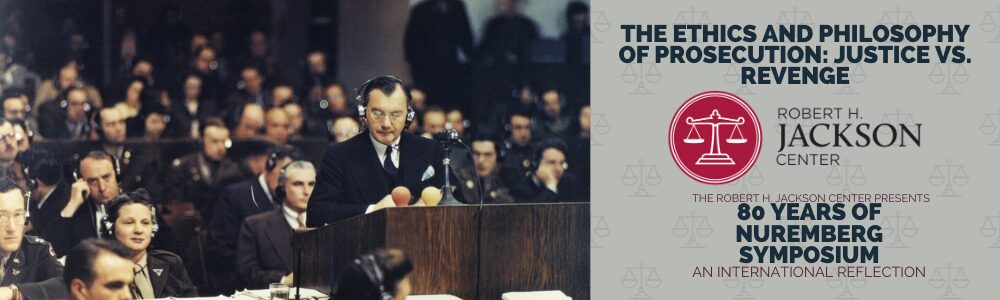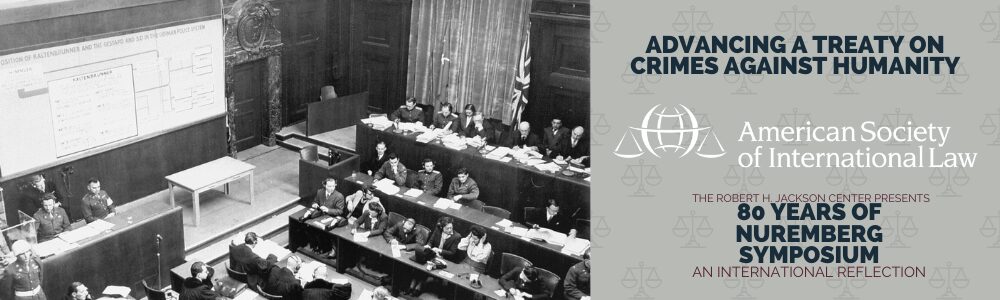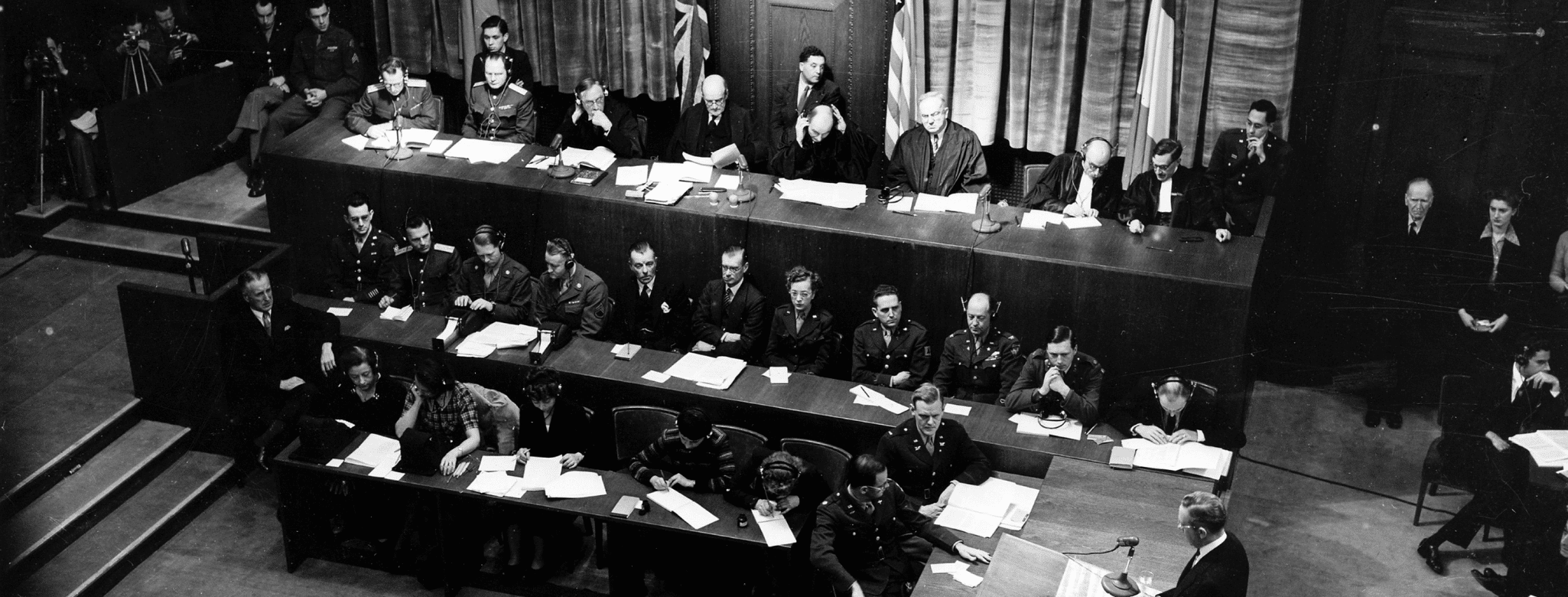
On September 30 and October 1, 1946, the International Military Tribunal (IMT) delivered its Judgment in the trial against the most high-ranking political and military leaders of the German Nazi regime, the Third Reich.
The Robert H. Jackson Center and the International Nuremberg Principles Academy commemorate the issuance of the Judgment of the IMT with a special event: Two virtually held roundtable discussions with high-profile participants, dedicated to dissecting the historical and legal implications of the Nuremberg Trial Judgment and the link to contemporary prosecutions of war crimes, crimes against humanity and genocide.
The two roundtables will cover the implications of the Judgment for the system of international criminal law. The first panel, on September 30, 2021 from 8:00 to 10:00 (ET) will analyze the legal aspects of the Judgment as a precedent for the evolution of the field of international criminal law. The speakers comprise are Chief Prosecutors who worked for the IMT's successors in international courts and tribunals established after 1990 by the United Nations and the international community.
Chair:
Stephen Rapp, Senior Visiting Fellow of Practice, Blavatnik School of Government, University of Oxford, former Prosecutor of the Special Court for Sierra Leone and Director of Prosecutions of the International Criminal Tribunal for Rwanda, former United States Ambassador-at-Large for War Crimes Issues.
Panelists:
The second panel on October 1, 2021 from 9:00 to 11:00 (ET) will discuss the challenges for the prosecution of international crimes today and will reflect on the legal implications of the judgment of the International Military Tribunal of Nuremberg for prosecutors today.
The second roundtable will comprise Prosecutors currently serving at the ICC and other international courts and tribunals whose mandate is the prosecution of core international crimes and the Federal Chief Prosecutor of Germany who is responsible for prosecutions in German courts under the principle of universal jurisdiction.
Chair:
Janet H. Anderson, International Journalist and Independent Consultant, The Hague
Panelists:
The Robert H. Jackson Center is a non-profit, non-partisan educational organization that is dedicated to presenting accurate and balanced information about complex issues. The opinions expressed by various guest speakers, panelists, and authors do not necessarily reflect the views of the Center, its Board, and supporters.
The Center fulfills its educational mission by welcoming diverse views and by providing a forum to explore a wide range of perspectives on often controversial legal and public policy issues. While we make an effort to ensure the information we provide is accurate and balanced, we welcome your comments, suggestions, or correction of any factual errors.
Since 2001, the Robert H. Jackson Center has preserved the values embodied in the life and works of Robert H. Jackson, who served as U.S. Solicitor General, U.S. Attorney General, U.S. Supreme Court Justice, and Chief U.S. Prosecutor of the International Military Tribunal at Nuremberg. Through programs, presentations, exhibits, media, internships, and scholarship, the Center seeks to demonstrate to current and future generations the relevance and applicability of Justice Jackson’s ideas and writings. The Center provides educational content on the United States Constitution and Supreme Court, civil rights, the legacy of the International Military Tribunal at Nuremberg and international human rights, and the rule of law. During his illustrious career, Justice Jackson addressed these subjects, and the Center recognizes his thinking remains relevant today.