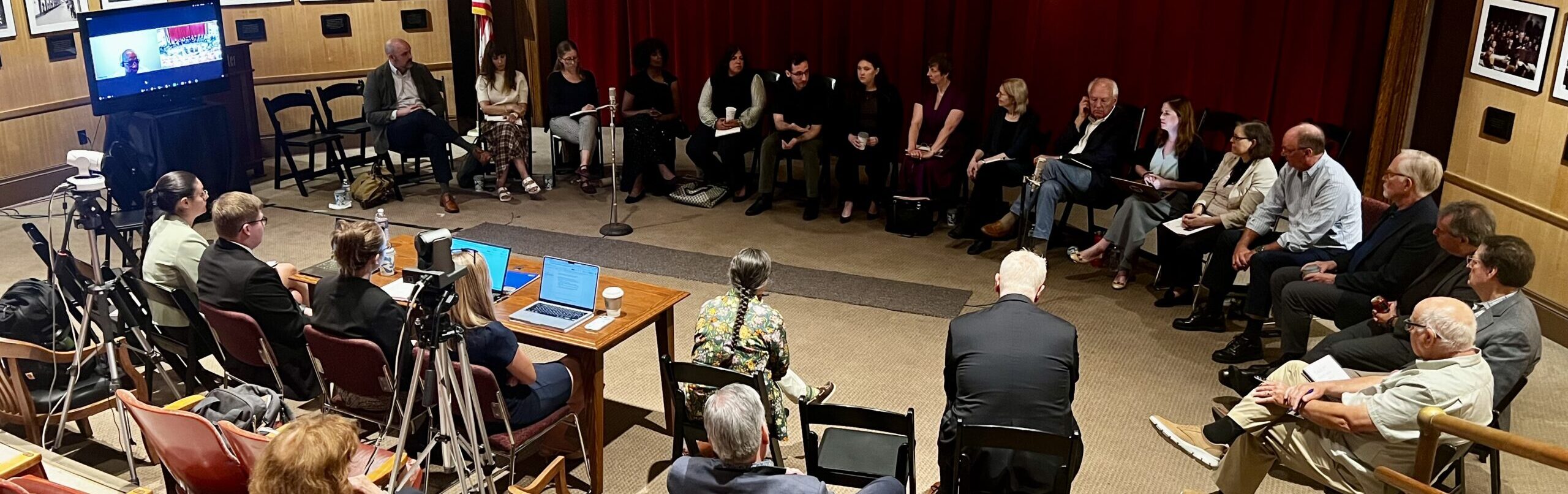
Eighty years ago this month, the International Military Tribunal at Nuremberg closed the evidentiary record on the first international war crimes trial in history, 218 trial days that changed the course of international law. That anniversary set the tone for this year's International Humanitarian Law Roundtable (IHLR) at the Robert H. Jackson Center, where prosecutors, judges, scholars, diplomats, and students gathered August 30 and 31 for a weekend built around a warning as old as the Book of Hosea: sow the wind, and you will reap the whirlwind.
"Eighty years after Nuremberg, the systems Jackson helped build are under considerable strain," Jackson Center President Kristan McMahon told the group as the Roundtable opened. "Some of that tension is expected, and other pieces come from conflicts that were not foreseen 80 years ago." Robert Jackson, she reminded the room, stepped away from the U.S. Supreme Court to insist that the rule of law, not vengeance, must judge even the worst of aggressors, a founding conviction that still shapes why the Center exists and why we host the IHLR each year.
A Weekend of Hard Conversations
The 18th IHLR, themed "Reaping the Whirlwind: The Rule of Law in an Age of Aggression," opened Sunday afternoon with the Ferencz Prosecutor Update, followed that evening by a screening and discussion of The Veto.
Monday's roundtables carried the weekend's real weight. The Chair opened with reflections on how far the world has drifted from the UN Charter's prohibition on the use of force, and on the uncomfortable ways international humanitarian law itself is sometimes invoked to justify aggression rather than restrain it. From there, the conversation turned deliberately toward what is working: places where international humanitarian law, its courts, and its institutions are holding up under strain, and what past periods of stress can teach about strengthening the system going forward. The final roundtable confronted the widening gap between the law as written and the law as observed, an increasingly selective and politicized application, and asked whether fact-finding commissions, UN inquiries, universal jurisdiction, sanctions, and international courts are still adequate tools for deterrence and response. The Chair closed the weekend with reflections tying the three conversations together.
Honoring Anton Korynevych
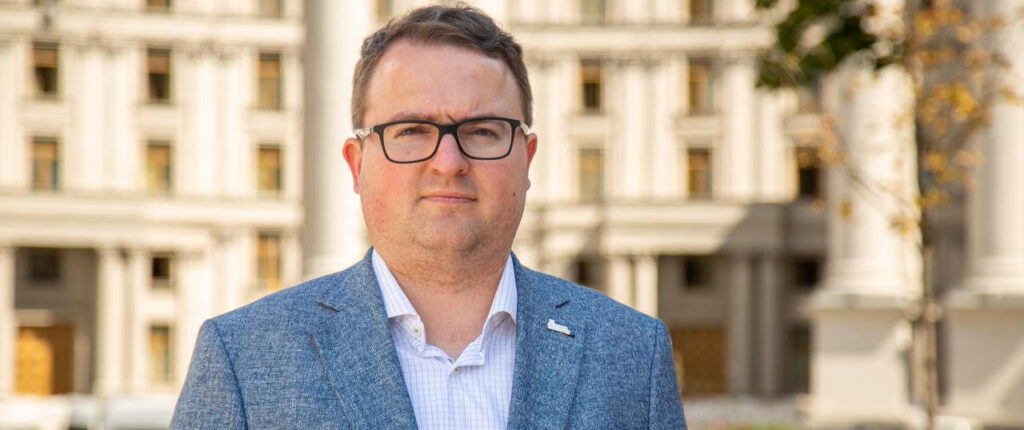
The weekend's emotional high point came Sunday evening, when the Jackson Center named Dr. Anton Korynevych the recipient of the 2026 Joshua Heintz Award for Humanitarian Achievement. Given annually since 2010 and sponsored by Josh and Janice Heintz, the award recognizes compassion, vision, and dedication in pursuit of international humanitarian justice.
"Throughout one of the defining international legal challenges of the 21st century, Dr. Korynevych has demonstrated extraordinary commitment to justice, accountability, and the rule of law," McMahon said in presenting the award. "His leadership in advancing international legal mechanisms to address aggression, war crimes, and the rights of victims reflects the values the Heintz Award was created to recognize."
Korynevych serves as Legal Adviser and Director for International Law of Ukraine's Ministry of Foreign Affairs and is the Agent of Ukraine before the International Court of Justice, where he has represented the country in landmark proceedings involving allegations of genocide, the suppression of terrorism financing, racial discrimination, civil aviation, and disputes under the UN Convention on the Law of the Sea. He also coordinates Ukraine's efforts to establish a Special Tribunal for the Crime of Aggression against Ukraine and currently heads a task force on the freezing, seizure, and confiscation of Russian assets. Alongside his diplomatic work, he is an Associate Professor of International Law at Taras Shevchenko National University of Kyiv and has spent more than a decade on issues of international humanitarian law, international criminal law, and the legal consequences of Russia's aggression against Ukraine, having previously served as Permanent Representative of the President of Ukraine in the Autonomous Republic of Crimea. His public service has been recognized with Ukraine's Order of Merit, Third Degree, the title of Honored Lawyer of Ukraine, and honors from academic, professional, and governmental institutions.
Accepting the award, Korynevych turned the recognition outward. "I consider this Award to be the award for all the Ukrainian lawyers who within all these years of the Russian Federation's aggression against Ukraine work hard in order to secure human rights, application of best international legal standards, rule of law and ensure justice and accountability," he said.
He spoke about Ukraine's cooperation with the International Criminal Court, its continued support for international humanitarian law, and the ongoing push to build both an international compensation mechanism for Ukraine and the Special Tribunal for the Crime of Aggression. "Even in darkest times, Ukraine believes in international law and works hard to make it stronger and more effective," he said, closing with a call for governments, legal experts, and civil society to keep supporting accountability for the crime of aggression and compensation for the war's victims, not only for Ukraine's sake but for the credibility of international law itself.
It was a fitting close to a weekend that opened with a reminder of what Nuremberg proved was possible, and spent two days asking what it will take to prove it again.
The International Humanitarian Law Roundtable is hosted in partnership with the American Society of International Law (ASIL), the Robert H. Jackson Center, and other sponsoring organizations. Proceedings from each Roundtable are published by ASIL. Learn more about the Jackson Center's programs at roberthjackson.org.