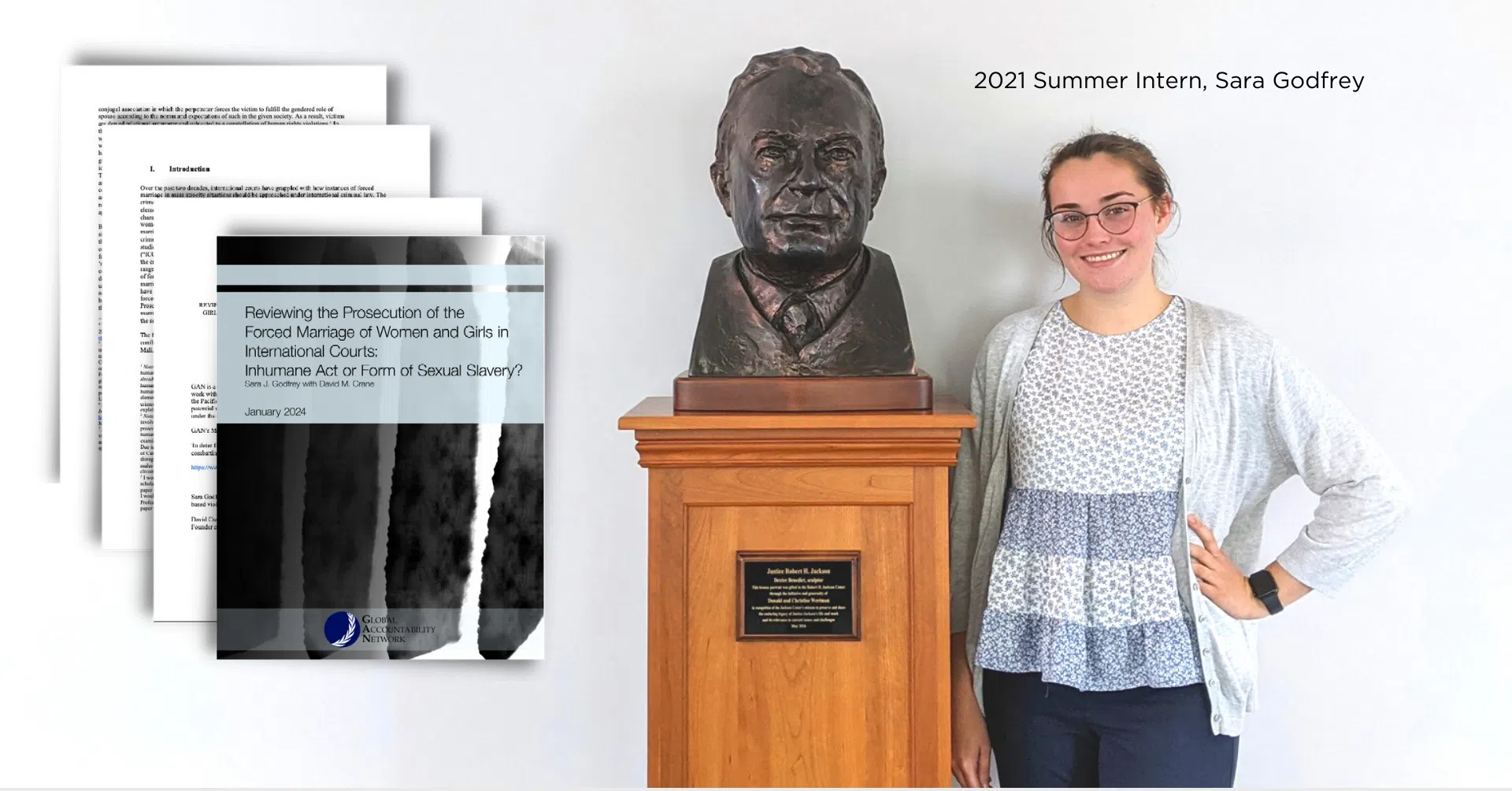
You never know where a summer job may take you.
Beginning her research as an RHJC summer intern in 2021, Sara Godfrey published an article this month evaluating the prosecution of forced marriage in international courts. Her article, Reviewing the Prosecution of the Forced Marriage of Women and Girls in International Courts: Sexual Slavery or Inhumane Act? examines the evolution of forced marriage in the eyes of international law, a crime that she argues has too often been confined to charges of sexual slavery. Godfrey, a 2022 graduate of Miami University, is currently a researcher with the Global Accountability Network (GAN), a nonprofit organization of international prosecutors and students aiming to secure justice for victims of atrocity crimes through documentation, research, and advocacy. GAN was founded by her supporting author, David Crane, the Founding Chief Prosecutor of the UN Special Court for Sierra Leone (SCSL). After expressing her interest in international law, Sara was connected with Prosecutor Crane during her summer internship at the RHJC. This connection, facilitated and supported by the Jackson Center, began a research endeavor extending over two years beyond her internship.
Sara’s work began with a broad question posed by Prosecutor Crane: “How has the prosecution of gender-based crimes evolved from Nuremberg, through the tribunals for the Former Yugoslavia and Rwanda, to Sierra Leone, and the ICC?” Godfrey began pondering this question during her internship with the Jackson Center, using the Center’s archives and vast sources on the Nuremberg era as a starting point. Choosing to continue her research with Prosecutor Crane after her internship, Sara joined GAN. After conducting a historical overview of the prosecution of gender-based crimes in international courts, together, Godfrey and Crane settled on the topic of forced marriage.
Unfortunately, the range of crimes committed against women and girls during armed conflict is vast – how did you decide to focus on forced marriage?
“I was struck by the international community’s focus on sexual violence when it comes to atrocity crimes committed against women and girls. While indeed necessary, especially given the lack of attention to sexual crimes at Nuremberg, I was curious about gender-based violence that was not confined to sexual acts, such as that present in forced marriage. Forced marriage highlights the fact that gender-based crimes are not limited to sexual violence, rather forced marriage is a broader gender-based crime as it often involes a sexual, social and domestic dimension. Therefore, I wanted to examine if international courts have been able to capture this distinction. Additionally, the topic of forced marriage as a distinct gender-based crime is also somewhat controversial, as international courts have repeatedly attempted to confine factual instances of forced marriage to the charge of sexual slavery, which in my view, incorrectly limits forced marriage to sexual violence. Prosecutor Crane shares this view, as he was the first international prosecutor to press charges of forced marriage as an inhumane act as a crime against humanity in Sierra Leone.”
What defines forced marriage in current ICC terms?
“The ICC’s most recent Policy on Gender-Based Crimes (published December 2023) describes forced marriage as ‘a situation in which a person is [forcefully] compelled to enter into a conjugal union with another person,’ thus violating a person’s right to freely choose their spouse. Typically, during forced marriages, victims are labeled ‘wives’ and forced to fulfill the socially constructed gendered expectations of a ‘wife’ in the given society. This often includes fulfilling all of their ‘husband’s’ sexual demands, serving as his exclusive partner, reproducing with him, raising his children, and completing all of the domestic duties assigned to ‘wives’ based on social norms, like cooking and cleaning. Victims often experience lasting social stigmatization and mental trauma due to being labeled a combatant’s ‘wife.’ Only recently, in the 2023 Policy Paper, has the ICC explicitly recognized forced marriage as a gender-based crime made up of sexual violence, reproductive violence, and broader gendered harms.”
It seems easy and obvious to lump forced marriage in with the crime of sexual violence, but your paper shows that raising these distinctions is a positive evolution for the ICC. Why is it important to highlight the uniqueness of the crime?
“Prosecutor Crane was really the pioneer in this area. His work at the SCSL opened the door to the prosecution of gender-based crimes beyond the predefined crimes related to sexual violence. We both share the view that accepting the status quo and prosecuting all gender-based violence through charges of sexual violence will ultimately limit the range of prosecutable offenses in the future and fails to capture the true experience of victims. Our paper maps the evolution of how, beginning with Crane’s work at the SCSL, international courts have slowly begun to move away from framing women and girls as victims of sexual acts alone, but rather as victims of a broader range of gender-based crimes – whether sexual, reproductive, or nonsexual. This is important given that fact that charges related to sexual violence may be unable to capture the range of harms that result from gender-based violence. For example, in the case of forced marriage, the harms endured by the victim are not limited to acts of sexual violence but also may include forced reproduction, domestic labor, and social stigmatization. Confining forced marriage to sexual slavery therefore fails to recognize the unique harms – beyond the sexual – that victims are forced to endure.”
Why do you think it has taken so long to evolve to our present definitions and sensibilities towards GBV?
“I believe that the historical tendency to view women and girls through the lens of their sexuality alone is why it has taken so long for the international community to come to recognize them as victims of a broader range of gender-based violence rather than victims of only sexual crimes. Prosecuting sexual violence is extremely important, especially as Nuremberg failed to prosecute documented instances of rape, sexual violence, and enforced prosecution. As a result, the tribunals for the Former Yugoslavia and Rwanda both intentionally focused on sexual violence, pushing back on the tendency to view the rape of women and girls as an inevitable consequence of war. However, this focus on sexual violence, while incredibly necessary and important, did begin to equate women and girls as victims of only sexual violence. So, understandably, it took some time (and push-back) to move away from this framing and begin to recognize the serious nature of other forms of gendered violence beyond the sexual realm.”
What are the lasting effects of the survivors?
“Victims of forced marriage experience a range of consequences that differ dramatically from victims of sexual slavery, particularly regarding the social dimension of the crime. The labeling of victims as combatants’ ‘wives’ often results in social stigmatization and psychological trauma that extends beyond the conflict. For example, in Sierra Leone, community reintegration was extremely difficult for many victims of forced marriage after the conflict as the labeling of victims as ‘wifes’ broke down social support structures and family ties. This largely arose from the exclusive nature of forced marriage as women and girls who were ‘married’ were viewed as more of an extension of their rebel ‘husbands’ than victims themselves. Therefore, victims of forced marriage tend to experience less sympathy and additional social hardship after conflict. In Sierra Leone, some community members viewed ‘bush wives’ as complicit in rebel activities like looting, with some believing that ‘bush wives’ benefited economically from the war. Further, many communities refused to raise ‘rebel children,’ making it impossible for some victims to return to their original homes and families after the war. Therefore, given the shame and stigma of being a rebel’s ‘wife,’ victims of forced marriage often suffer lasting psychological harm and social isolation post-conflict.”
How does publication by GAN further the development of international humanitarian law?
“Alongside other scholars, particularly Dr. Valerie Oosterveld and Dr. Melanie O’Brien, our paper contributes to the contextualization of forced marriage as a broader gender-based crime. This work is important as the international community approaches instances of gender-based violence that are not confined to, or captured by, charges related to sexual violence alone.”
What are your current and next areas of research for you?
“Well, I am expecting to begin graduate school this fall. I’ll be pursuing a masters in international affairs specializing in human rights, conflict, and international law. So, I hope to continue similar research on the prosecution of atrocity crimes committed against vulnerable groups such as children, women and girls, and migrants. I would love to examine the intersection of childhood and gender in conflict as overlapping identities that create additional vulnerability. I am also interested in studying instances of gender-based persecution, which has recently been charged in the al Hassan case. Similar to forced marriage, gender-based persecution also highlights how critical it is to distinguish between gender-based violence and sexual violence, as like forced marriage, gender-baseded persecution also involves gendered harms that are not confined to sexual acts. I’m very interested to see how the charge of gender-based persecution holds up at the ICC and would definitely be interested in researching such.”
How has the recent Prosecutor v. Ongwen case at the ICC contributed the understanding of forced marriage as a distinct crime?
The Ongwen Case suggests significant progress in the ICC’s orientation towards forced marriage as a gender-based crime. In this case, the ICC successfully charged forced marriage as an inhumane act for the first time. Ongwen was convicted of both sexual slavery and forced marriage as an inhumane act as two separate crimes against humanity.
Applications for this summer’s internship class are now being accepted… visit our website for more information.