
Nuremberg Trial, International Military Tribunal, 1945-1946
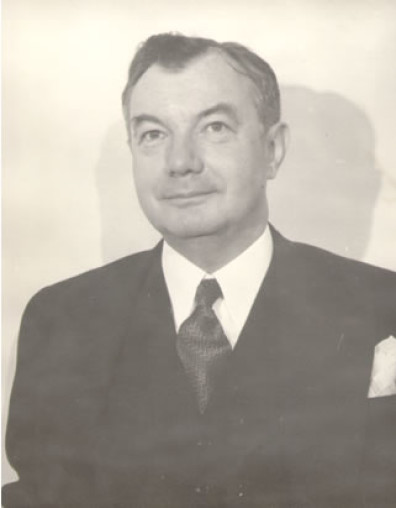
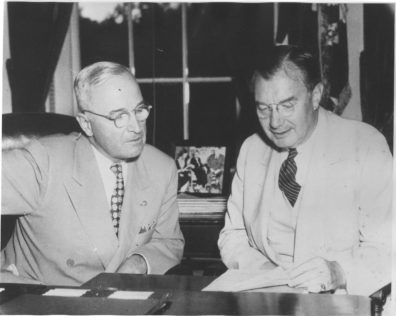
On May 2, 1945, President Harry S. Truman appointed Associate Supreme Court Justice Robert H. Jackson as chief prosecutor for the United States in the proposed trials of Nazi war criminals. President Truman gave Justice Jackson free rein to choose his own staff and to design and implement the trials.
During the summer of 1945, Jackson worked at achieving a consensus among the Allies and was finally successful when an agreement between the American, British, French, and Soviet governments was signed on August 8th. This agreement, called the London Charter, became the basis for the trial before the International Military Tribunal. Beginning on November 20, 1945, the first Nuremberg trial lasted for almost ten months. Jackson himself cross-examined three of the 22 defendants, Hermann Goering, Albert Speer, and Hjalmar Schacht. Jackson gave the opening and closing statements, two of the most eloquent and important addresses in international law.
It was through the energy, intelligence and leadership of Justice Jackson that the Nuremberg Trial was organized and carried out, standards of evidence developed, rights of defendants defined, and prosecutorial action commenced. Jackson was the driving force behind the conduct of the trials themselves. Jackson said the most important work of his life was at Nuremberg, where his diligence and vision set legal precedents that continue to affect the international law community today.
May 02, 1945 - The Appointment
On May 2, 1945, President Harry S. Truman appointed Justice Robert H. Jackson to act as the representative of the United States and as its Chief of Counsel in preparing and prosecuting charges of atrocities and war crimes against the leaders of the European Axis powers and their principal agents and accessories. Justice Jackson was appointed Chief Prosecutor by Executive Order 9547.
In The Nuremberg Roles of Justice Robert H. Jackson, Professor John Q. Barrett writes, “As a matter of branding, President Truman’s decision to appoint Jackson to prosecute Nazi war criminals was a strong statement indicating how seriously the United States took the prosecutions. It prompted the British, the Soviets and the French to appoint counterpart chief counsel of capability, high rank and sufficient authority to represent their nations.”
Jackson's Notes
The President released on May 2nd a statement that I would undertake the task. It received considerable publicity and I was immediately deluged with applications for jobs. The executive order defined my authority.
I was designated to act as representative of the United States and as its chief counsel “in preparing and prosecuting charges of atrocities and war crimes against such leaders of the European Axis … as the United States may agree with any of the United Nations to bring to trial….” I was to receive no additional compensation, but should receive my expenses.
I was given broad authority by the executive order. One reason probably was that the other authorities were willing to get rid of the problem by delegating responsibility to me. In the second place, it was a totally unploughed field
Jun 06, 1945 - The Report to the President
Robert H. Jackson’s report to President Harry S. Truman was submitted June 6, 1945, and released to the public June 7, 1945. The report summarized his first month of work as the Chief of Counsel. Jackson’s report covered five key points: 1. How his work to prosecute major war criminals was being reconciled with other, ongoing war crimes prosecutions; 2. The preparation of the American case and the progress made with allied counterparts on a trial agreement; 3. An outline of the prosecution’s plan, including the commitment to fair trials not summary executions; 4. The prosecution’s foundation in international law; and, 5. The need for immediate action in starting the trial.
Jackson's Notes
We then went to work with might and main to get out a report to the President on a plan for conducting the trials. The staff devoted itself to it almost constantly. The President revealed the report at a press conference, gave copies of it to the press, and said that he had completely approved it as expressing the American position. Many men had been very skeptical about a trial because they could see no plan for it, felt that the project hadn’t been thought through, that it was carelessly entered upon and that it was likely to run amuck. On reading this report they had a new confidence in our enterprise
Jun 26, 1945 - The London Conference, June 26-August 2, 1945
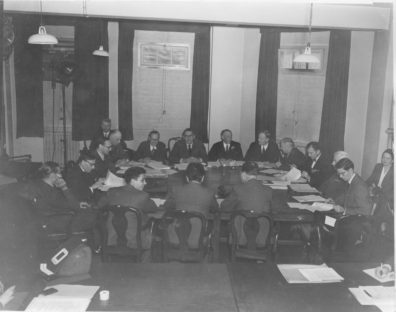
For over a month, during the summer of 1945, representatives of the Soviet, French, U.S. and U.K. governments attempted to reconcile their conflicting legal concepts and devise a workable procedure for the trial. At the core of these intense negotiations was Robert H. Jackson. Jackson refused to back down on certain legal principles, most importantly, the position that aggressive warfare was an international crime. “Our view, is that this isn’t merely a case of showing that these Nazi Hitlerite people failed to be gentlemen in war; it is a matter of their having designed an illegal attack on the international peace.” After weeks of discussions, that included debates on individual responsibility, state sovereignty, definitions of aggression, the issue of retroactivity, and the causes of war, the Allies created the first International Criminal Court. The delegates at the London Conference defined crimes that are now the foundations of modern international law.
Jackson's Notes
The conference at London was planned for June 25, 1945. We arrived and were ready for it, as were all of the other delegations but the Russian delegation did not appear until June 26th, when the conference finally got under way. Criticism of my appointment, upon the grounds that the President should not have called upon a member of the Supreme Court, would have to be weighted in the light of its affect on the choice of representatives of the other countries. There was no doubt that the position of justice of the Supreme Court carried with it great weight with foreign delegations in two ways. In the first place, the representative who held that life position of the independence and power had among the legal profession a good deal of prestige by reason of the office
Aug 08, 1945 - The London Agreement & Charter
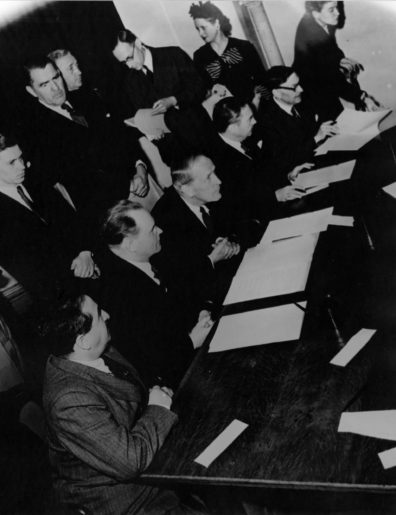
The London Agreement created the IMT and its Charter. The Charter of the International Military Tribunal – Annex to the Agreement for the prosecution and punishment of the major war criminals of the European Axis – defined the laws and procedures by which the Nuremberg trials were to be conducted.
Jackson's Notes
On August 8, 1945 we signed the agreement, as I was authorized to do on behalf of the United States, and it was announced to the world. Up to that time there had been some press rumors that we were having difficulties in arriving at it. We had frankly admitted we had, but there had been no exploitation of our differences.
I may say that the chief critics of it were a few international lawyers who simply could not adjust themselves to the idea that the world had moved since the time of the Hague Conventions and that the treaties outlawing war and renouncing it as an instrument of policy had made a change in the old doctrine that it always is legal for a country to go to war for aggressive ends if it pleased its interests to do so.
The Reminiscences of Robert H. Jackson Columbia Univ. Oral History Research Office, 1955
Nov 20, 1945 - The Indictment
The four chief prosecutors of the International Military Tribunal (IMT)–Robert H. Jackson (United States), Francois de Menthon (France), Roman A. Rudenko (Soviet Union), and Sir Hartley Shawcross (Great Britain)–handed down indictments against 24 Nazi officials, and named 6 organizations or groups as criminal. The indictment was first filed on October 18, 1945, in Berlin, and was read on the first day of the trial, November 20, 1945. Only 21 defendants appeared in court. German industrialist Gustav Krupp was included in the original indictment, but he was elderly and in failing health. It was decided in preliminary hearings to exclude him from the proceedings. Nazi Party secretary Martin Bormann was tried and convicted in absentia. Robert Ley committed suicide on the eve of the trial.
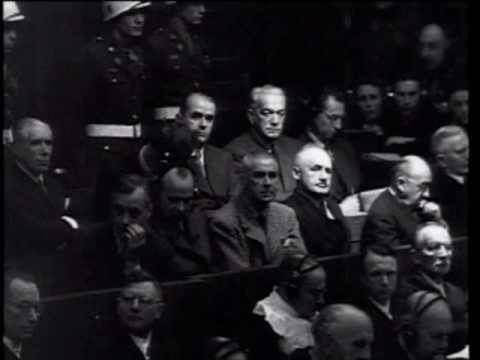
Nov 21, 1945 - Justice Robert H. Jackson’s Opening Statement
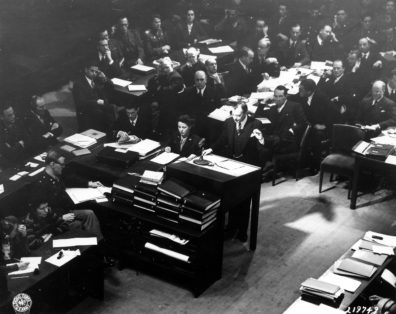
U.S. Supreme Court Justice Robert H. Jackson, appointed by President Truman to serve as United States Chief of Counsel to prosecute Nazi war criminals, delivers his opening statement to the four-nation International Military Tribunal (IMT) at Nuremberg on November 21, 1945. Here are five segments of Jackson’s speech, which is deemed a forensic masterpiece: (1) at the call of IMT President Lord Geoffrey Lawrence (UK), Jackson begins; defense attorneys sit in the background; (2) Jackson speaks, assisted by his secretary Elsie Douglas and his son and executive assistant, attorney William E. Jackson; the camera pans across the defense attorneys and then the 21 defendants; (3) as Jackson continues, the camera pans across UK chief prosecutor Hartley Shawcross and deputy David Maxwell Fyfe and then to the 8 judges on the bench, including U.S. judge Francis Biddle and U.S. alternate judge John J. Parker; (4) Jackson speaks and the defendants listen; (5) Jackson addresses the imperfection but sufficiency of the case that prosecutors will present.
Jackson's Notes
So the task that immediately fell to me was to prepare the opening speech which I would deliver, and to get the evidence arranged for presentation in the following week to support my opening remarks. The speech seemed an important task to me because up to that time no one had disclosed to the world what the case really amounted to, what the evidence was and what law we were contending for.
The speech also seemed to have important public consequences because it would be the first full disclosure of the materials that we had captured and had at hand, and of the use we attempted to make of them. I had a rather strong sense of responsibility about the speech and recognized that it was probably the most important task of my life.
The Reminiscences of Robert H. Jackson Columbia Univ. Oral History Research Office, 1955, Pages 1390-1392
Nov 23, 1945 - The Nazi Party
The International Military Tribunal established to hear evidence against 21 of the leading Nazis commenced in Nuremberg Germany on November 20, 1945. On the 3rd day, Col. Robert Story made initial statements regarding the methodology of gathering and presenting evidence. An excerpt shows Ralph Albrecht introducing the complex structure and organization of the Nazi Party and government apparatus. He is followed by Major Frank Wallis who was responsible for the submission of evidence against the “Nazi Conspirators.”
Nov 27, 1945 - Dr. Siemers
On November 27, 1945, Dr. Walter Siemers, counsel to defendant Erich Raeder, objected to the use of interrogations of witnesses or defendants in which he was not present.This excerpt, in German, argues the issue of pre-trial interrogation. President Judge Lawrence ruled that is copies of the transcript of interrogations were used, copies should be furnished to the defense counsel. The Tribunal further ruled that if the Defense wished to submit evidence gained from interrogation of a defendant, then the defendant must be placed on the witness stand.
Nov 27, 1945 - Aggressive War
The International Military Tribunal established to hear evidence against 21 of the leading Nazis commenced in Nuremberg Germany on November 20, 1945. On the 6th day of the Trial (Nov. 27, 1945), Mr. Sidney Alderman began the presentation of evidence on the planning, initiating and waging of aggressive war (Count One). In this excerpt he displays charts showing the Nazi taking of Czechoslovakia. He then reads from a paper written by General Jodl entitled “Strategic Position in the Beginning of the 5th year of the War” delivered to German Reich and Gauleiters in Munich on Nov. 7, 1943.

Nov 29, 1945 - Concentration Camp Film
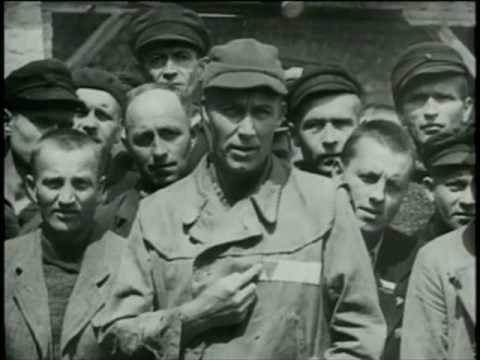
On Nov. 29, 1945, the eighth day of the Trial, there was a dramatic change in the nature of the presentation of the Prosecution: a film on the Nazi concentration camps. Associate Prosecutor James Donovan introduced the film. Some observers thought it was perhaps the most powerful and moving evidence of the Trial. The graphic portrayal aroused strong emotions in the defendants’ dock. The film was compiled from motion pictures taken by Allied military photographers as the Allied armies in the West liberated the areas in which these camps were located. The narration was taken from the military photographer’s notes.
Nov 30, 1945 - Hess at Nuremberg, Admitting He Faked Loss of Memory
November 30, 1945, hearing before the International Military Tribunal, Nuremberg. Attorney Von Rohrscheidt, representing Hess, applies to suspend proceedings because of Hess’s loss of memory and inability to plead. The IMT president, Lord Geoffrey Lawrence (UK), questions. Argument by the chief U.S. prosecutor, Justice Robert H. Jackson. Hess then speaks, admitting that he falsely claimed amnesia, including to his counsel, for tactical reasons, and that henceforth his comprehension will be unimpaired.

Nov 30, 1945 - Hess
The International Military Tribunal at Nuremberg conducted a Hearing on Nov. 30, 1945 to review evidence regarding Rudolf Hess’ competence to stand trial. Towards the end of the Hearing and to the surprise of all in the Courtroom, Hess made a statement that would have far-reaching consequences. Here is the declaration in German.

Nov 30, 1945 - Lahousen
Former German General Erwin Lahousen was one of the few survivors of the small German group which plotted an unsuccessful assassination of Hitler in July 1944. On Nov. 30, 1945 Lahousen testified as the first live witness in the Trial . He was questioned by Colonel John Harlan marshall, chief of the Interrogation Section of the American Prosecution. His testimony gained great attention given his rank as a section chief of the German Abwehr of the Armed Forces under Admiral Canaris and the fact he had Canaris’ diary. Goering was incensed.
This untranslated excerpt shows his direct testimony handled by Amen, Judge Biddle and Judge Rudenko. Also, a cross examination by German defense counsel.

Dec 05, 1945 - Maxwell-Fyfe
The third week of the Trial saw the British put on their case dealing with Count on Aggressive War and Violation of Treaties. After the opening statement by Sir Hartley Shawcross, Deputy Chief British Prosecutor, Sir David Maxwell-Fyfe on December 5, 1945, dealt with how Count Two would be handled. He outlined that the Nazis had entered into a score of treaties which had been broken. His purpose was to build a clear record concerning the fundamentals of international law applicable to the case on aggressive war (both Counts One and Two).

Dec 05, 1945 - British Opening Statement
The International Military Tribunal established to hear evidence against 21 of the leading Nazis commenced in Nuremberg Germany on November 20, 1945. On the 12th day (Dec. 4, 1945) Sir Hartley Shawcross, the British Chief Prosecutor and the Attorney General of Great Britain presented the opening statement dealing with aggressive war and beach of treaties. The British prosecution staff focused on Count 2 of the Indictment. Sir Hartley underlined the significance of building a record which showed the suffering caused by aggression and the violation of treaties and the need for a world order with the power to hold responsible those who break the rules of law.
Dec 10, 1945 - Kaltenbruner’s Plea
On the 16th day of the Trial, Dec. 10, 1945, the Defendant Ernst Kaltenbruner was brought into the dock for the first time. He had been confined in a nearby Army hospital with a circulatory illness. He was the deputy to Reichsfuehrer Heinrich Himmler. He plead not guily and said “I do not believe i have made myself guilty”.
He was followed by Sidney Alderman, Counsel to the American Delegation, who presented the case on Collaboration with Italy and Japan and the Case on Aggressive War against the United States.
Dec 11, 1945 - Servatius
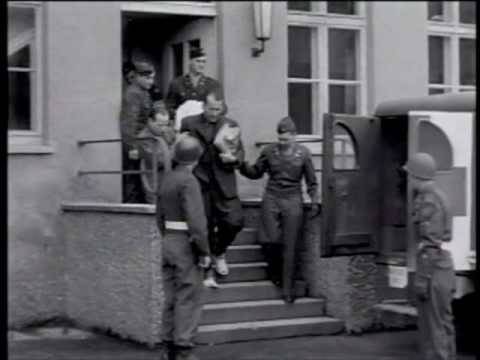
On Dec. 11., 1945, Thomas Dodd, deputy American prosecutor, during his presentation on “The Exploitation of Forced Labor”, was introducing a memorandum dated April 17, 1943 written by Dr. Lammers, when Dr. Robert Servatius objected to the fact that this memorandum had not been provided to the Defense. Judge Lawrence ruled that the prosecution should make such documents available on a timely basis.
Dec 11, 1945 - The Nazi Plan II
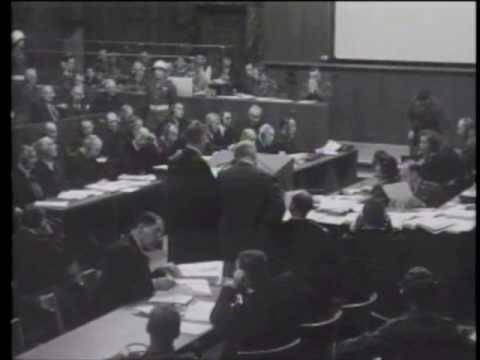
December 11, 1945 marked another memorable occurrence. Almost the entire day was devoted to the showing of captured German films. Commander James Donovan supervised the production of the film entitled “Nazi Plan”. It was a comprehensive review of the Nazi period as portrayed by German photographers. It was divided into four parts: 1. “The Rise of the NSDAAP, 1921-33; 2. “Acquiring Control of Germany, 1933-35”; 3. “Preparation for Wars of Aggression, 1935-39”; and 4. “Wars of Aggression, 1939-1944”.
Dec 11, 1945 - The Nazi Plan
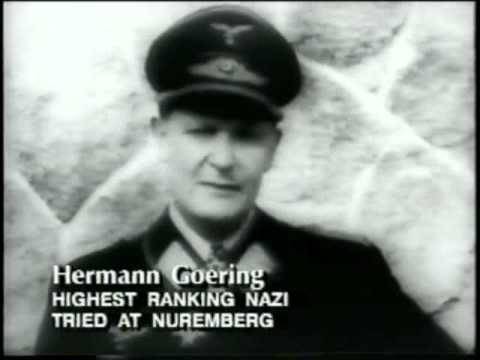
The 17th day of the Trial, Dec. 11, 1945, marked another memorable day . Almost the entire day was devoted to the showing of captured German films. Commander James Donovan, an Assistant Trial Counsel, supervised the production of the film entitled The Nazi Plan”. It was a comprehensive review of the Nazi period portrayed by German photographers. It was divided into four parts: 1.”The Rise of the NSDAP, 1921 to 1933; 2. “Acquiring Control of Germany, 1933-1935; 3. “Preparation for Wars of Aggression, 1935-1939; 4. “Wars of Aggression, 1939-1944”.The introduction to this excerpt relating to part 1 of the film is by Fred Graham of Court TV, which produced a ten hour documentary on the Nuremberg Trial.
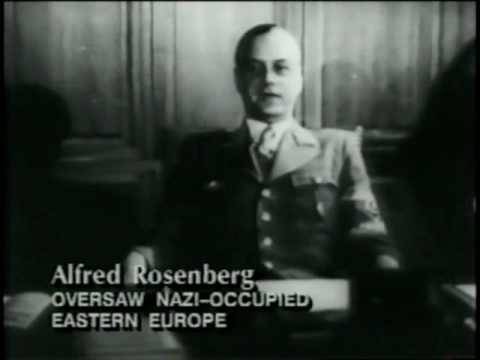
Dec 12, 1945 - Forced Labor
The use of slave labor by Nazi Germany, its operation of the concentration camps , and its persecution and extermination of the Jews and Gypsies produced more tragedy for more people than any other Nazi behavior except aggressive wars. Thomas Dodd, American Trial counsel presented the case entitled “The Exploitation of Forced Labor”. Dodd’s presentation dealt in great detail with the activities of the Defendant Fritz Sauckel, Plenipotentiary General for Manpower, and of the Defendant Albert Speer, Reich Minister of Armaments and Munitions.

Dec 13, 1945 - The Concentration Camps
The first major submission on the concentration camps was made by Thomas Dodd on Dec. 13, 1945. “The concentration camp was one of the fundamental institutions of the Nazi regime in the battle against the Jews, the Christian Church, labor, those who wanted peace and opposition and nonconformity of any kind.
This excerpt displays evidence relating to the Mauthausen Concentration Camp, photographs of tattooed human skin taken at the Buchenwald Camp and a shrunken human head. He also presented evidence of death books kept at the Mauthausen Concentration Camp.

Dec 14, 1945 - The Persecution of Jews
On Dec. 14, 1945, Maj. William F. Walsh, of the American Delegation, continued his presentation of the case of the persecution and murder of the Jews. This excerpt displays evidence regarding the use of gas vans for execution and the treatment of Jews in the Occupied Parts of the Soviet Union.

Dec 17, 1945 - The SA
December 17, 1945 saw Col. Robert Storey commence a presentation on the Leadership Corps of the Nazi Party, the Reich Cabinet and the Storm Troops (SA). He re-emphasized the central point of the Prosecution’ theory of the case: “The Nazi Party was the central core of the Common Plan or Conspiracy,…a conspiracy which contemplated and embraced the commission of Crimes against the Peace, War Crimes, and Crimes against Humanity.” To show the structure, Col.Storey introduced a chart from a magazine of the Nazi Party entitled “The Face of the Party”.

Dec 17, 1945 - The Plunder of Art
On Dec. 17, 1945, Col. Robert Storey, the first Executive Trial Counsel of the American Prosecution, made the first submission on the plunder of art to the Tribunal. He declared that “he would bring to the attention of the Tribunal and of the world the defendants vast, organized, systematic program for the cultural impoverishment of virtually every community of Europe and for the enrichment of Germany thereby”. This excerpt depicts the presentation of the confiscation of Jewish homes especially in Paris. He then presented 39 volumes of photographs of the works of art seized by Einsazstab Rosenberg.
Dec 20, 1945 - The Gestapo and The SD
This was the last session of the Nuremberg Trial prior to the Christmas recess (Dec. 20, 1945). Col. Robert Storey, Executive Trial Counsel of the American Delegation, presented the case against the Accused Organizations- the Gestapo and the SD. The Gestapo or Secret Police was a state organization known for its dreaded network of police agencies which operated first in Germany and then in the German-occupied countries. The SD or Security Service was an early branch of the SS. The Indictment charged that it developed “into a vast espionage and counter-intelligence system which operated in conjunction with the Gestapo”. The presentation dealt with the activites of the SD before the War. Also, the simulated attack on the Gleiwitz Radio Station which was the provocation for the invasion of Poland. Col. Storey also outlined the activities of the Einsatzgruppen (Special Task Forces) of the Security Police and the SD which employed the use of “death vans” in Russia.

Dec 20, 1945 - The SS
Dec. 20, 1945 saw the continuation of the presentation of the case against the SS. Major Warren F. Farr, an assistant trial counsel of the American Prosecution team, introduced evidence against the SS (Schutzsaffeln) of the Nazi Party which was mentioned at almost every stage of the Trial. Major Farr dealt with the General SS (Allgemeine SS), which had developed into a huge military-type organization. It was estimated that the overall number of members was probably 750,000.The Reichsfuehrer SS and Chief of the German Police in the Ministry of Interior was Himmler.
Jan 02, 1946 - Graebe/ Hess
On Jan. 2, 1946, Col. Robert Storey read at length from one of the most striking pieces of evidence in the entire Trial, the affidavit of Herman Graebe, the former manager of a Josef Jung firm in the Ukraine. This affidavit was later quoted at some length by the Tribunal in it Judgment. During the reading Rudolf Hess was in extremis and left the defendant’s dock. There are two different angles of Hess’ illness.

Jan 02, 1946 - Kaltenbruner
The first presentation on the individual responsibility of a defendant was made by Lt. Commander Whitney Harris of the American Delegation on January 2, 1946. It dealt with the Defendant Ernst Kaltenbruner, successor of the notorious Reinhard Heydrich, Chief of the Security Police and SD and head of the Reich Security Head Office (RSHA). Harris introduced, through affidavits by a number of SS officials, the evidence that Kaltenbruner was responsible for the punishment and the execution on various pretexts of many concentration camp inmates and slave laborers.

Jan 02, 1946 - The Gestapo
Following the Christmas recess of the Nuremberg Trial, on Jan. 2, 1946, Col. Robert Storey continued his presentation of the The Accused Organizations-the Gestapo and the SD. His initial presentation was the affidavit of Herman Graebe, the former manager of a branch of the Josef Jung firm in the Ukraine. He described the killing of Jews in the Ukraine. Col. Storey then presented a Gestapo directive regarding the treatment of prisoners of war in Russia. Assisting Col. Storey was Lt. Whitney Harris. Shortly after the presentation, Col. Storey left the Prosecution staff.
Jan 03, 1946 - Wisliceny
On January 3, 1946, Lt. Colonel Smith W. Brookhart, Jr. of the American Delegation called to the stand SS Captain Dieter Wisliceny. He testified regarding Adolf Eichmann who was a section chief in the Reich Security Main Office (RSHA). His section was concerned with the Jewish question. Eichmann had special powers from SS Gruppenfuehrer Mueller and as a result was responsible for the so-called Jewish question in Germany and in all countries occupied by Germany. When asked how many Jews were killed under this program, Wisliceny said Eichmann personally “always talked about at least four million Jews”.
Jan 03, 1946 - Ohlendorf II
The 26th day of the Trial (Jan. 3, 1946) saw the witness Otto Ohlendorf called to the stand by American Prosecutor John Harlan Amen. Ohlendorf was an SS General and for one year was chief of Einsatzgruppe D. His testimony, in German, was partially gleaned from an interrogation conducted by Lt. Commander Whitney Harris of the American Delegation. He testifies to the fact that Group D operated in the southern Ukraine and describes its objectives.
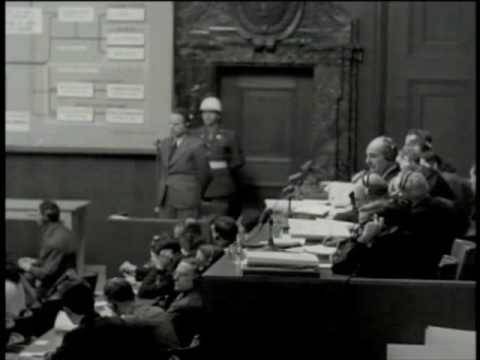
Jan 03, 1946 - Ohlendorf
On Jan. 3, 1946, Colonel John Amen, Associate Trial Counsel for the American Delegation, called SS General Otto Ohlendorf . He testified that for one year, beginning in June 1941, he had been chief of Einsatzgruppe D and the representative of the Chief of Sipo (Security Police)) and SD with the 11th Army. He testified that the term Einsatzgruppe first appeared in the Poland campaign. He stated that officials would have at their disposal mobile units; gas vans for killing. He testified as to the positions of Kaltenbrunner, Eichmann and Muller.

Jan 04, 1946 - Schellenberg
After Col. John Amen concluded his direct examination of SS General Walter Schellenberg, several defense counsel cross examined. In the segment on Jan. 4, 1946, he is examined by Dr. Kauffmann, counsel to Kaltenbrunner, and by Dr. Kubuschok, counsel to the SA and SD. Schellenberg, in German, testified regarding the powers of Kaltenbrunner with regards to the concentration camps.

Jan 07, 1946 - The High Command
The last presentation of the American Prosecution on the accused organizations concerned the General High Staff and High Command of the German Armed Forces. This submission was made by Colonel Telford Taylor on Jan. 7-8, 1946. The presentation outlined that all of the accused criminal groups or organizations were related. The group wanted to “aggrandize Germany at the expense of neighboring countries and were prepared to do so by force or the the threat of force”. This excerpt deals with the Hitler directive of how to deal with paratroopers and other prisoners of war.

Jan 07, 1946 - Church Suppression
Colonel Leonard Wheeler, Assistant American Trial Counsel, on Jan. 7, 1946, submitted the case regarding the Oppression of the Christian Churches and other religious groups in Germany and the occupied countries. He stated that the Nazi conspirators found the Christian churches to be an “obstacle to their complete domination of the German people and contrary to their master race dogma”. The Indictment charged that “the Nazi conspirators, by promoting beliefs and practices incompatible with Christian teaching, sought to subvert the influence of the churches over the people and in particular the youth of Germany”.

Jan 07, 1946 - Bach Zelewski II
On Jan. 7, 1946, General Telford Taylor called to the stand SS Obergruppenfuehrer Erich von dem Bach-Zelewski. He testified that at the beginning of the war he was a Higher SS and Police Leader in the central section of the campaign against the Soviet Union. “My principal task was fighting partisians.” He stated that “the principal task of the Einsatzgruppen was the annihilation of the Jews, Gypsies and political commissars.” At the end of 1942, he became the Chief of Anti-Partisan Combat Units for the entire Eastern Front. He confirmed that orders were issued by the highest authorities that German soldiers committing excesses were not to be punished in the military courts.

Jan 07, 1946 - Bach-Zelewski
On Jan. 7, 1946, Colonel Telford Taylor of the American Prosecution staff called SS Obergruppenfuehrer Erich Von dem Bach-Zelewski who gave revealing testimony regarding the Einsatzgruppen. After Taylor completed his direct, Col. Pokrovsky of the Russian Delegation examined him regarding the treatment of Slavs. He stated that the German directive was to reduce the number of Slavs by 30 million. On cross-examination by Dr. Franz Exner, defense counsel to the German High Command, the witness testified regarding the proportion of enemy dead to enemy prisoners. Finally, Dr. Kraus elicited a response to a speech given by Schacht.

Jan 08, 1946 - Goering
On January 8, 1946, Ralph Albrecht, an associate trial counsel of the American Delegation, made the individual presentation against the Defendant Herman Goering. He presented documents which covered Goering’s activities from the Munich Putsch in 1923 to his demands in 1944 that additional concentration camp inmates be made available to work in the air armaments industry.

Jan 09, 1946 - Rosenberg
The presentation of the American Prosecution against Alfred Rosenberg on January 9-10, 1946 was delivered by Walter W. Brudno, who had been a Private First Class in the U.S. Army until two weeks before the presentation. The main emphasis of the submission had to do with Rosenberg’s numerous activities in connection with the war including setting up the Institute for the Exploration of the Jewish Question.

Jan 10, 1946 - Schacht
On Jan. 10-11, 1946, Navy Lt. Brady O. Bryson made the principal submission on the individual responsibility of Hjalmar Schacht, President of the Reichsbank and Reich Minister of Economics. At the time of the indictment most of the prosecution staff shared Justice Jackson’s view that Schacht was a major conspirator because of his role in bringing Hitler to power.

Jan 10, 1946 - Streicher
On Jan. 10, 1946, the presentation of the case against Julius Streicher, Racial Propagandist and Gau Leader of Franconia, was made by Lt. Colonel Mervyn Griffith-Jones of the British Delegation. Streicher’s views were presented in his newspaper Der Sturmer. In Januarary 1937, Himmler wrote that future history would state “that Julius Streicher and his weekly Der Sturmer would have contributed a great deal towards the enlightenment regarding the enemy of humanity (the Jews)”.

Jan 10, 1946 - Frank
The Case against the Defendant Hans Frank was mainly concerned with his role as the Governor General of Occupied Poland and his close connection to the murder and ill-treatment of the Jews. Some of the most incriminating evidence against Frank came from the diary he had meticulously kept. The presentation of individual responsibility of Frank was made by Lt. Col. William H. Baldwin, an Assistant Trial Counsel of the American Delegation on Jan. 10, 1946.

Jan 11, 1946 - Blaha II
On Jan. 11, 1946, Thomas Dodd, The Executive Trial Counsel of the American Prosecution, called to the stand Dr. Franz Blaha. Dr. Blaha was a physician who was an inmate at the Dachau Concentration Camp from April 1941-April 1945. After reading an affidavit of Dr. Blaha, Dodd questioned Blaha about visitors to Dachau. Among the prominent visitors he mentioned was Reichsfuehrer SS Himmler and six of the defendants – Kaltenbruner, Rosenberg, Frick, Funk, Sauckel and Bormann.

Jan 11, 1946 - Blaha
On Jan. 11, 1946, Dr. Franz Blaha was the first inmate of a concentration camp to be called as a witness before the Tribunal. Thomas Dodd, one of the two Executive Trial Counsel of the American Prosecution, commenced the testimony by reading from an affidavit of the witness, who was a medical doctor interned in the Dachau Concentration Camp from April 1941-April 1945. Blaha stated that five doctors, whom he named, performed operations on healthy prisoners including malaria experiments, experiments on the effect of changing air pressure and submersion in cold water, among others.

Jan 11, 1946 - Direct Examination of Blaha
The first inmate of a concentration camp to be called was Dr. Franz Blaha. He had been interned in the Dachau Concentration Camp from April 1941 until the camp was liberated by the Americans in April 1945. Thomas Dodd had initially conducted the direct examination (which is on a separate clip). He was followed by M. Charles Dubost, Deputy Chief Prosecutorfor France. Blaha testified in German on French prisoners and on the so-called “Kommandantur-Arrest”, a bunker were the “prominent personalities” were situated including Schiuschnigg and Martin Niemoeller. Next follows cross-examinations by Funk’s attorney concerning his client and Rosenberg’s attorney concerning secrecy at the Camp. Finally Chief Judge Lawrence questioned them concerning the various entities that were at the Camp including the SS, SD and Gesatpo.

Jan 14, 1946 - Heisig
On Jan. 14, 1946, during the case against the Defendant Karl Doenitz, Col. Harry J. Phillimore of the British Delegation called Peter Josef Heisig, oberleutnant zur See in the German Navy. He testified regarding the speech of Admiral Doenitz and the order not to rescue enemy sailors and the rationale behind it. Doenitz’s counsel, Dr. Otto Kranzbuehler cross-examined Heisig.

Jan 14, 1946 - Doenitz
On Jan. 14, 1946, the submission on the individual responsibility of Karl Doenitz, Commander of the Submarine Arm of the Navy and Commander-in-Chief of the Navy, was made by Colonel H.J. Phillimore, junior counsel for the British Delegation. His submission included calling two former German captains of U-boats who testified concerning an order of Doenitz that the killing of shipwrecked crew members was to be encouraged. In concluding, Phillimore declared that Doenitz “was an extreme Nazi who did his utmost to indoctrinate the Navy and the German people with the Nazi creed”. This segment from Court TV’s documentary on the Nuremberg Trial also shows the cross-examination by Dr. Otto Kranzbuehler, counsel for Doenitz.

Jan 15, 1946 - Moehle
The submission on the individual responsibility of Doenitz was made by Co. H.J. Phillimore, junior counsel for the British Delegation on Jan. 14-15,1946. Col Phillimore’s presentation included the calling of former German U-boat Captain Moehle who testified concerning an order from Doenitz that the killing of shipwrecked crew members was to be encouraged. The cross examination came from Doenitz’s counsel, Dr. Otto Kranzbuehler, Fleet Judge of the German Navy.

Jan 16, 1946 - Bormann
The Prosecution’s submission on the individual responsibility of Martin Bormann was delivered on Jan. 16, 1946 by Lt. Thomas Lambert, an American Assistant Trial Counsel. Lambert emphasized Bormann’s role in the suppression of the churches, the persecution and evacuation of the Jews, the treatment of foreign workers and prisoners of war, and the lynching of Allied airmen.

Jan 17, 1946 - de Menthon’s Opening Statement
On January 17, 1946, Francois de Menthon, the chief French prosecutor, opened the case on behalf of the French prosecution. “The conscience of the peoples, who only yesterday were enslaved and tortured both in soul and body, calls upon you to judge and to condemn the monstrous attempt at domination and barbarism of all times….”

Jan 17, 1946 - French Opening Statement
The French delegation began their case on the 36th day of the Trial. Jan. 17, 1946 saw M. Francis de Menthon, the first of two chief prosecutors for France, deliver the French opening statement. The French Delegation had the principal responsibility for presenting the argument and proof concerning War Crimes and Crimes against Humanity committed by Nazi Germany in the countries of Western Europe. The Soviet Delegation had a similar responsibility for crimes committed in Eastern Europe. The translated segment of this post is excerpted from Court TVs ten hour series entitled “Nuremberg Trials,” which aired in 1995. The commentator is Fred Graham. The balance of the excerpt is in French and from the original film. Immediately following his opening statement, de Menthon was called to France to serve a Minister of Justice. He was replaced by Champetier de Ribes.

Jan 18, 1946 - Faure
Edgar Faure, Deputy Chief French Prosecutor, continued the French Opening regarding the crimes against peace on January 18, 1946. Faure concerned himself with the German activities in Norway. He presented documents relating to the psychology of the occupation.

Jan 19, 1946 - Herzog
On January 19, 1946, the French Opening continued with a presentation by Jacques B. Herzog, Assistant French Prosecutor. He presented evidence regarding the German workforce, including 738,000 French workers who were pressed into compulsory labor service. He noted that defendant Fritz Sauckel was willing to take responsibility for the treatment of foreign workers. He cited a report where Sauckel admitted that there were 5 million foreign workers in Germany, of whom 20,000 were actually volunteers.

Jan 21, 1946 - Gerthoffer
On January 21, 1946, Charles Gerthoffer, French Prosecutor, continued the French Opening by outlining the pillage committed in the occupied countries. The German wholesale requisitions of agriculture products clearly left the local population with insufficient amounts to assure their subsistence.

Jan 22, 1946 - Delpech
Henry Delpech on January 22, 1946 continued the French Opening regarding the crimes against peace. Delpech read a report where one German officer wrote “I attach the greatest importance to the proposition that the factories in the occupied territories, Holland, Belgium and France, be utilized as much as possible to ease the strain on the German armament production and to increase war potential”.

Jan 23, 1946 - Fritzsche
On Jan. 23, 1946, Capt. Drexel Sprecher of the American Prosecution Delegation made the principal submission against Hans Fritzsche, Head of the Home Press Division and Chief Radio Propagandist. During the last years of the war he broadcasted weekly to the German people in a program “Hans Fritzsche speaks.” Sprecher stated that even “Defendant Streicher, the master Jew-baiter of all time, could scarcely outdo Fritzsche in some of his slander against the Jews”.

Jan 23, 1946 - von Papen
January 23, 1946 saw the submission of the case against Franz von Papen, Vice Chancellor in Hitler’s first cabinet and German minister to Austria and to Turkey. The presentation was made by Major J. Harcourt Barrington, a Junior Counsel of the British Delegation. Barrington characterized von Papen as an “unscrupulous opportunist” who was well practiced in duplicity.

Jan 26, 1946 - Lampe
On Jan. 5, 1946, French Prosecution presented the first of seven witnesses on deportations and concentration camps. Maurice Lampe testified that he was imprisoned in France by the Germans for two and a half years beginning in November 1941. Then in March 1944 he was interned in the Mauthausen Concentration Camp in Austria. Lampe testified that Himmler had visited Mauthausen to witness the shooting of fifty Soviet prisoner of war.

Jan 26, 1946 - Nelte/Dubost
On Jan. 25, 1946, French Prosecutor M.Dubost read evidence against Wilhelm Keitel. He referred to the infamous “Night and Fog ” decree and mentioned that it was the words of Keitel. Keitel’s counsel, Dr.Otto Nelte, objected and said the Decree was conceived by Hitler but signed by Keitel. The court said Dubost did not err and let him proceed with his witness Lampe.

Jan 26, 1946 - Nelte
On Jan. 25, 1946, Dr. Otto Nelte, Counsel for Defendant Wilhelm Keitel, in German objected to the French Prosecutor Dubost’s reference to the “Nacht und Nebel” (Night and Fog) decree as being the words of his client. Dubost responded by saying “that Keitel had signed it, but that Hitler had conceived it. Therefore, I made allusion to the military honor of this general, who was not afraid to become the lackey of Hitler.”

Jan 28, 1946 - Dupont
Buchenwald internee Victor Dupont was examined by French prosecutor M. Dubost regarding activities in the camp. In this vignette he testified that in 1944 a convoy of several hundred Gypsy children arrived and were assembled and then sent to Auschwitz to be gassed.

Jan 28, 1946 - Veith
French Prosecutor, M. Dubost, called Jean Frederic Veith, an internee of the Mauthausen concentration camp on January 26, 1946. He testified that he had to sign a statement never to reveal what happened there. He indicated that he saw Himmler, Kaltenbrunner, Pohl and Maurer at the camp.

Jan 28, 1946 - Vaillant-Couturier II
On January 28, 1946, French deputy prosecutor Dubost called Marie Claude Vaillan-Coutrier to the stand. This is a continuation of her testimony as noted in Part 1. She testified that “One night we were awakened by horrible cries. the next day we learned that the Nazis had run out of gas and the children had been hurled into the furnace alive.” She further stated that of the 230 French women who arrived with her, only 49 survived.

Jan 28, 1946 - Vaillant-Couturier I
On Jan. 28, 1946, deputy French prosecutor Charles Dubost called Marie Claude Vailant-Coutrier, age 33, to the stand. She had taken leave of her post as a deputy in the French constituent assembly to testify. When France fell, she was arrested as a journalist and ordered to sign a false confession, which she refused to do. She was sent to Auschwitz. She describes in great detail the procedures employed at Auschwitz and its conditions.

Jan 28, 1946 - Vaillant-Couturier (English)
On three successive days near the end of January 1946, The French Prosecution called seven witnesses who testified about deportation and internment in concentration camps. On Jan. 28, 1946, French Prosecutor M. Charles Dubost called Madame Claude Vaillan-Courtier as a witness. She was an inmate of the Auschwitz and Ravensbrueck concentration camps. She was deputy in the Constituent Assembly of France and a Knight of the French Legion Of Honor. She distinguished Between Auschwitz and Ravensbrueck, stating that in Auschwitz the aim was extermination, whereas at Ravensbrueck the aim was output in either the munitions or powder factories. She also explained the system of selection for extermination in the camp.
Jan 29, 1946 - Balachowsky
On January 29, 1946, Alfred Balachowsky, a Buchenwald concentration camp internee, was called by French prosecutor M. Dubost regarding activities at the Buchenwald concentration camp. He testified that he was able to get a hold of the archives of Block 46 and was able to note all the experiments that were recorded in the archives. Block 46 was the infamous block for experiments where the internees were utilized as guinea pigs.

Jan 29, 1946 - Rudenko’s Opening Statement II
In Russian, this is a vignette of the opening statement presented by General Roman Rudenko, Chief Russian Prosecutor. The case was presented on Feb,. 8, 1946 to a packed courtroom. He opened by stating “for the first time in the history of mankind is justice confronted with crimes committed on so vast a scale, with crimes which entailed such grave consequences. It is the first time that criminals who have seized an entire state and made this state an instrument of their monstruous crimes appear before a court of justice. “

Jan 29, 1946 - Rudenko’s Opening Statement
In Russian, this is a vignette of the opening statement presented by General Roman Rudenko, Chief Russian Prosecutor. The case was presented on Feb,. 8, 1946 to a packed courtroom. He opened by stating “for the first time in the history of mankind is justice confronted with crimes committed on so vast a scale, with crimes which entailed such grave consequences. It is the first time that criminals who have seized an entire state and made this state an instrument of their monstruous crimes appear before a court of justice.”

Jan 29, 1946 - Cappeln
During the French prosecution on deportations and concentration camps, M. Dubost called Hans Cappeln, a Norwegian businessman who had been a lawyer. He testified that he was arrested and placed in a Gestapo prison in Oslo, where he was repeatedly beaten. From Oslo, he went to several camps in Germany.

Jan 29, 1946 - Boix II
On January 29, 1946, M. Dubost, French Prosecutor, called Francois Boix, Mauthausen Concenteration Camp internee, to the stand to talk about acivities of the Camp. Following his testimony, General Roman Rudenlo, the chief Russian Prosecutor, inquired about the extermination of Russian prisoners at the Camp.

Jan 29, 1946 - Boix
On three successive days near the end of Jan. 1946, the French Prosecution called seven witnesses who testified about deportations and internment in concentration camps. On Jan. 29, 1946 Francois Boix testified that he was a Spanish refugee interned at Mauthausen. In this excerpt, he is cross examined by Hans Babel, co-counsel for the SS. He describes the colored stars inmates wore and his tasks and duties as an interpreter.
Feb 01, 1946 - Reuter
M. Faure of the French Delegation made a long presentation on Germanization in Western Europe and on persecution on political, racial and religious grounds. On Feb. 1, 1946 he called to the stand Emil Reuter, a lawyer and President of the Chamber of Deputies of the Grand Duchy of Luxembourg. He testified that although the Germans never proclaimed the annexation of Luxembourg, German measures were equivalent to an annexation. Approximately 4,000 Luxembourgers were deported to concentration camps.

Feb 02, 1946 - Vorrink II
On Feb. 2, 1946, French Prosecutor M. Faure questioned Jaccobus Vorrink, a Dutch Senator and President of the Socialist Party of the Netherlands regarding the nazification of Holland. He was cross examined by EDR. Gustav Steinbauer, Counsel for the Defendant Seyss-Inquart, inquired regarding the ruling individuals and tried to obtain testimony regarding Seyss-Inquart’s benevolent rule.

Feb 02, 1946 - Vorrink I
On Feb. 2, 1946, M. Faure of the French Delegation commenced the presentation of the Germanization in Western Europe and the persecution on racial, political and religious grounds. M. Faure questioned Jaccobus Vorrink, a Dutch Senator and President of the Socialist Party of the Netherlands. He testified that the Dutch National Socialist Party was a much hated and small group. Over time the Germans placed Dutch National Socialists in key positions in the Dutch administration. The persons “behaved like cowardly Nazi lackeys”.

Feb 04, 1946 - Van der Essen II
This is a segment of the presentation by the French prosecution led by M. Faure on the Germanization in Western Europe, including persecution on political, racial and religious grounds. The witness is professor Van der Essen at the University of Louvain in Belgium and a member of the Belgian Commission on War Crimes. After testifying about the destruction of the library of the University, he stated that the Germans imposed groups of Belgian collaborators on the country as burgomasters and aldermen. He stated over 300 members of the University died as victims of the Gestapo. after being sent to a concentration camp.

Feb 04, 1946 - Van der Essen I
The last witness during the French prosecution on Germanization in Western Europe and persecution on political , racial and religious grounds was Van der Essen, a history professor from Belgium and a member of the Belgian Commission on War Crimes. On Feb,. 4, 1946 after testifying about the destruction of the library of the University of Louvain by the Germans, he stated that the Germans imposed groups of German collaborators on the country as burgomasters and alderman. On cross examination, Dr. Exner asked about the presence of the British there at the time.

Feb 07, 1946 - Hess
The last presentation on the individual responsibility of defendants was devoted to the Defendant Rudolf Hess, Hitler’s principal deputy in the Nazi party and the Nazi leader who drew worldwide attention when he flew an airplane from Germany to Scotland in 1941. The presentation of this case to the Tribunal was delayed until the French Prosecution had completed its case because of a disabling accident to Hess’ first defense counsel. The submission was made by Lt. Colonel J.M.G. Griffith-Jones of the British Delegation on Feb. 7, 1946.

Feb 08, 1946 - Karev
On Feb. 8, 1946 and after General Rudenko’s opening statement, Colonel D.S. Karev, assistant Soviet Prosecutor, made a statement in Russian that the evidence submitted by the Soviet Prosecution would include official government reports by agencies of the Soviet Union, Czechoslovakia, Poland and Yugoslavia. They objected to the introduction of evidence contrary to official government reports of the Soviet Union.

Feb 08, 1946 - Russian Opening Statement
On Feb. 8, 1946, the case presented by the Soviet Prosecution began and continued with several interruptions until March 4, 1946. The opening statement was delivered by the chief Soviet Prosecutor General Roman Rudenko. Before a crowded courtroom, Rudenko began by stating; “For the first time in the history of mankind is justice confronted with crimes committed on so vast a scale, with crimes which have entailed such grave consequences. It is the first time that criminals who have seized an entire state and made this state an instrument of their monstrous crimes appear before a court of justice. It is also for the first time that , by judging these defendants, we sit in judgment only of the defendants themselves, but also on the criminal institutions and organization which they created and on the inhuman theories and ideas which they promulgated….”

Feb 09, 1946 - Pokrovsky II
Nuremberg Day 55 Pokrovsky

Feb 09, 1946 - Pokrovsky I
On Feb. 9, 1946, Colonel Y. V. Pokrovsky, the Deputy Chief Prosecutor for the Soviet Union continued the Russian opening statements on aggression in Eastern and Southern Europe. He declared that the “Tribunal will remember that the annihilation of Slavism and the destruction of democratic principles was one of the basic aims of the fascist conspiracy”.

Feb 11, 1946 - von Paulus I
On the third day of the Soviet case ( Feb. 11, 1946), Field Marshal Friedrich von Paulus testified. He had been Commander-in-Chief of the German 6th Army in the battle of Stalingrad in late 1942 and early 1943. Eventually he surrendered. Many of the defendants were furious that von Paulus was about to testify as a prosecution witness. The testimony was directed by Russian Chief Prosecutor Roman Rudenko. Von Paulus testified in German about the invasion of the Soviet Union and the invasion of Romania, Hungary and Finland. Further he identified the Nazi hierarchy. The German defense team through Dr. Laternser prevailed upon the Tribunal to delay cross examination to gather more information.

Feb 11, 1946 - Paulus II
On Feb. 11,1946, Field Marshal Friedrich Paulus, Commander-in-Chief of the 6th Army in the battle of Stalingrad in late 1942-early 1943 was called to the stand by General Roman Rudenko, Chief prosecutor of Russian Delegation.

Feb 11, 1946 - Paulus I
The Soviet prosecutors made two presentations concerning the initiation of aggression in Eastern and Southern Europe and called two high ranking German military officials, Field Marshal Paulus and General Buchenhagen to testify. When Assistant Soviet Prosecutor Zorya announced that Paulus would be produced as a prosecution witness, there was great excitement among the defendants.
On Feb. 11, 1946, Paulus testified about the invasion of the Soviet Union and the participation of Romania, Hungary and Finland. Paulus stated that the “whole aim was conquest for the purpose of colonizing Russian territory; and by exploitation and looting them the war in the West was to be carried to an end, with the object of finally establishing supremacy over Europe”. This excerpt is in German and shows the direct examination by Russian prosecutor Zorya followed by cross examination By Dr. Nelte, counsel for Keitel.

Feb 12, 1946 - Buschenhagen
On Feb. 12, 1946, Assistant Soviet Prosecutor, N.D. Zorya, introduced General Buschenhagen during the Soviet submission aggression on Eastern and Southern Europe. This excerpt deals with the relationship in Finland. The testimony is in German.

Feb 12, 1946 - von Paulus II
On Feb. 12, 1946, the cross examination of Field Marshal Friedrich von Paulus was conducted by Dr. Nelte, counsel for the defendant Keitel. In German, Paulus agreed “that the General Staff of the Army with its large machinery was to work out details which Hitler conceived.” Paulus stated that “From the way in which this task was started one could see that, after the theoretical preparation, a practical application would follow.”
Dr. Fritz Sauter, counsel for the defendants Funk and Schirach, asked about the legalities of the Soviet invasion.

Feb 19, 1946 - Smirnov
Feb. 19, 1946, Counsellor Smirnov concluded his presentation of crimes “against the peaceful population of the countries of Eastern and Southern Europe.” On the third day of his presentation, he discussed the activities of the Danzig Anatomic Institute which conducted human experiments. He stated that the Institute had successfully concluded experiments in converting human fat into soap. He next presented samples of semi-tanned human skin. The conclusion of the War was the only thing which precluded the successful experiments on tanning of human skin.

Feb 19, 1946 - Russian Film
On Feb. 19, 1946, Chief Counsellor of Justice L.N. Smirnov of the Russian Delegation presented case of the Offenses Against Civilians and Crimes Against Humanity of the countries of Eastern and Southern Europe. He concluded his presentation by showing a documentary film entitled “The Atrocities of the German Fascist Invaders in the U.S.S.R.”

Feb 20, 1946 - Shenin
On Feb. 20, 1946, State Counsellor L.R. Shenin, an assistant Soviet Prosecutor, presented the case entitled “The Despoliation and Plunder of Private, Public, and National Property.” He declared that spoliation and plunder in the Soviet Union was planned in advance of the invasion. He also dwelt on the Nazi Plans regarding Czechoslovakia, Poland, Yugoslavia and Greece.

Feb 21, 1946 - Raginsky
The Spoliation of Property and the The Destruction of Villages was presnted by State Counsellor M.Y. Raginsky, an assistant Soviet prosecutor. General Rudenko introduced Raginsky and the subject formally entitled “The Destruction and Plunder of Cultural and Scientific Treasures, Cultural Institutions, Monasteries, Churches, and Other Religious Institutions, as Well as the Destruction of Cities and Villages.” His presentation dealt with the Einsatzab Rosenberg, the pillage and destruction in Czechoslovakia, Poland, Yugoslavia and The Soviet Union.

Feb 22, 1946 - Orbelli
During the Soviet presentation on the spoliation of property and the Destruction of Cities and Villages, State Counsellor M.Y. Raginsky, assistant Soviet prosecutor, called Joseph Orbelli, the Director of the State Hermitage. He stated that the Hermitage were under systematic artillery shelling and bombardment, causing considerable damage to the building and its contents. The shelling occurred over a period of months, causing him to conclude it was intentional. On cross- examination, Orbelli noted that though the Hermitage was located in the center of Leningrad, there were no artillery batteries anywhere nearby.

Feb 26, 1946 - Kivelisha
On Feb. 26, Counsellor Smirnov called to the stand Dr. Eugene Kivelisha, a junior physician in a rifle division of the Red Army. He was captured by the Germans in August 1941, deprived of water and food for 4 days and forced to march. Attempts by the population to feed him were repulsed.

Feb 26, 1946 - Grigoriev
During the presentation by the Russian prosecution of the Offenses against Civilians and Crimes against Humanity, L.N. Smirnov, Chief Counsellor of Justice from the Russian Delegation, called Jacob Gigoriev, a peasant from the Soviet District of Pskov near Leningrad. He testified that Kusnezovo, the village in which he lived, no longer exists. On Oct. 28, 1943, “German soldiers suddenly raided our village and started murdering the peaceful citizens, shooting them, chasing them into the houses.” 47 persons in the village were killed. No defense counsel chose to cross-examine.

Feb 27, 1946 - Lomakin
The last witness of Counsellor Smirnov under the Russian presentation of the Offenses Against Civilians and Crimes Against Humanity was Rev. Nikolai Lomakin, a Russian Orthodox priest. He testified principally about the bombing of churches and other religious buildings in Leningrad during the time that city was surrounded by German forces. He noted that it was strange that the shelling intensified during feast days.

Feb 27, 1946 - Rajzman
On Feb. 27, 1946, Counsellor Smirnov, Russian prosecutor, called Samuel Rajzman, an inmate of the Treblinka concentration camp. He testified that Treblinka was known as the “Road to Heaven”. He noted that an average of three transports of 60 cars each day arrived at Treblinka. In 1941 there were fewer. “On an average, I believed they killed in Treblinka from ten to twelve thousand person daily.”

Feb 27, 1946 - Schmaglevskaya
During the Russian presentation of the Offenses against Civilians and Crimes against Humanity, L.N. Smirnov, Chief Counsellor of Justice, called Severina Schmaglevska concerning “the attitude of the German Fascists toward the children in concentration camps.” She had been interned in the Birkenau section of the Auschwitz concentration camp from October 1942-Jan. 1945. She stated in Russian that children born in the camp were promptly taken from their mothers. If Jewish, they were put to death. Non-Jewish were put in a special block to be delivered to unknown destinations. No defense counsel elected to cross-examine.

Feb 27, 1946 - Suzkever
On Feb. 27, 1946, Chief Counsellor of Justice L.N. Smirnov of the Russian Delegation called Abram Suzkever, a Jewish writer from Vilna, as a witness. He testified that about 80,000 Jews had lived in Vilna before German occupation. In 1941, The Germans initiated a pogrom in Vilna. At the end of the German occupation there were only 60 Jews who survived with the remainder, approximately 79,400 having been exterminated. No defense counsel chose to cross-examine.

Feb 28, 1946 - Jackson on Criminality of Nazis II
Chief American Prosecutor, Robert H. Jackson, continued a speech concerning the prosecution’s case against certain organizations in the Nazi government. Justice Jackson stated that these organizations were not selected without considerable study by the prosecution. These organizations were the most vicious of all those in Germany. Membership was entirely voluntary. The indicted included the Reich Cabinet, The Gestapo and SD, the Nazi party leaders and their high level staff members.

Feb 28, 1946 - Jackson on Criminality of Nazis I
Justice Robert H. Jackson, the chief U.S. prosecutor of the Nazis at Nuremberg, delivered the opening of his argument to the International Military Tribunal on the criminality of the indicted Nazi organizations on February 28, 1946.

Mar 08, 1946 - Bodenschatz II
On March 8, 1946, General Karl Bodenschatz, military adjutant to Goering as General of the German Air Force, is cross examined by Robert H. Jackson, the chief American prosecutor.

Mar 08, 1946 - Bodenschatz I
On March 8, 1946, Robert H. Jackson, chief American Prosecutor cross examined General of the Air Force Karl Bodenschatz, military adjutant to Goering. He testified that, upon Goering’s instruction, he had helped perhaps ten to twenty Jews who had been arrested or were threatened with arrest.

Mar 08, 1946 - Robert H Jackson & Bodenschatz
On Day 77, General of the Air Force, Karl Bodenschatz, was the first witness to appear for the defendant Goering. Justice Robert H Jackson elected to cross-examine him as well as the following four Defense witnesses. The testimony involves the assertion that, upon Goering’s instructions, he had helped Jews who were threatened with arrest. Jackson’s cross examination took place March 8, 1946.

Mar 11, 1946 - Robert H Jackson & Milch
On Day 78, Erhard Milch, the former Field Marshall, was the second witness for the Goering defense. Justice Jackson cross examined him on March 11-12, 1946. Jackson attempted to establish that Germany was prepared for war.

Mar 12, 1946 - Kesselring
The last witness Dr. Stahmer called before calling his client Hermann Goering was Field Marshal Albert Kesselring. His testimony was that he assisted in building up the German Air Force for defensive purposes. He testified that he had not heard anything about the extermination of the Jews in the East. He was on the stand March 12-13, 1946.

Mar 12, 1946 - Robert H Jackson & Koerner
On Day 79, Paul Koerner, Chief of the Office of the four year plan and member of the Central Planning Board, was the fourth witness for the Goering defense. Justice Jackson cross examined him on March 13, 1946.

Mar 12, 1946 - Direct Examination of Koerner
On March 12, 1946, Dr. Stahmer, lead Defendant Hermann Goering’s Counsel, called Paul Koerner, State Secretary in the Prussian State Ministry, chief of the Office of the Four Year Plan, and member of the Central Planning Board. Koerner testified, in German, that the Gestapo was established for the purpose of watching ” the enemies of the state.” The concentration camps were intended to receive “elements hostile to the State, mainly Communists.” After the Roehm Putsch, Goering had heard that innocent people might have fallen. He asked Hitler to cease and “no further unauthorized action took place”. Thereafter, Koerner was cross examined by Justice Robert h Jackson.

Mar 12, 1946 - Robert H Jackson & Brauchitsch
On Day 79, Colonel Bernd von Brauchitsch was the third witness to appear for the Defendant Goering. He was the first military adjutant of Goering as Commander-in-Chief of the Air Force. He was cross examined by Justice Jackson on March 13, 1946.

Mar 12, 1946 - Direct Examination of Von Brauchitsch
On March 12, 1946, as part of the witnesses on behalf of Defendant Hermann Goering, Dr. Stahmer called Colonel Bernd von Brauchitsch, the first military adjutant of Defendant Goering. Goering, Brauchitsch testified in German, was against Hitler’s measures of lynching downed Allied airmen. He also testified that the German people had confidence in Goering to the end and cited two examples.

Mar 13, 1946 - Direct Examination of Goering V
Part 3 of testimony on the first day of direct examination of lead Defendant Hermann Goering (March 13, 1946). His testimony directed by his counsel, Dr. Stahmer, covers the concentration camps in Prussia, the Thalmann incident and his alleged benevolence in helping inmates and their families and on one Christmas (1933) releasing lighter cases.
Mar 13, 1946 - Direct Examination of Goering IV
This excerpt is a continuation of the first day ( March 13, 1946) of testimony by lead Defendant Hermann Goering. The direct examination was conducted by his counsel, Dr. Stahmer. The testimony concerned the collapse of the Von Papen Cabinet, the creation of the Gestapo and the concentration camps and acknowledged acts of brutality but ‘compared to all that has happened in the past and the greatness of the events, this German revolution of freedom is the least bloody and the most disciplined of all revolutions known to history”.

Mar 13, 1946 - Direct Examination of Goering III
In a continuation of the direct testimony of defendant Hermann Goering on March 13, 1946, he testified as to the how and why of the necessity of consolidating power with a strong National Socialist governments. He also explained the legality surrounding its creation. He also justified the Fuehrer’s combination of the head of the state with the head of the government.

Mar 13, 1946 - Direct Examination of Goering II
The lengthy testimony of the Defendant Hermann Goering was among the highlights of the Trial. He was on the witness stand for ten court days, a longer time by far than any other witness. Goering first took the stand on March 13, 1946 with the direct examination being conducted by his counsel, Dr. Stahmer. Answers to questions were often long and discursive with Justice Lawrence allowing great leeway.
In this excerpt, Goering, in German, discusses his early relationship with Hitler, the November 9, 1923 Munich Putsch and the negotiations leading to the appointment Hitler as Chancellor in January 1933.

Mar 13, 1946 - Direct Examination of Goering I
A vignette from March 13, 1946 direct examination from Dr. Otto Stahmer of his client, Hermann Goering. He testified of his days leading to his involvement in the Nazi party. He mentioned attending a rally in 1922 where Hitler spoke and his focus on Germany’s mistreatment in the Treaty of Versailles.
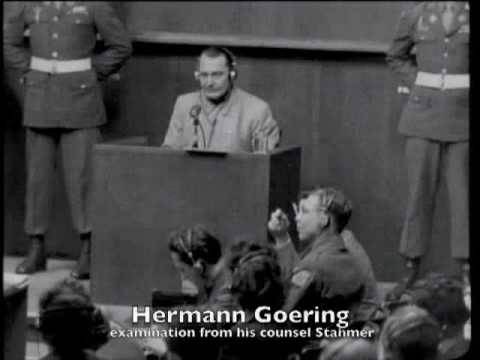
Mar 13, 1946 - Cross Examination of Kesselring III
On Day 80, the last defense witness for Goering was Field Marshall Albert Kesselring. He was cross examined by Justice Robert H Jackson on March 13, 1946. Kesselring stated that “the Hague Convention on land warfare did not provide for the requirements of air warfare.

Mar 13, 1946 - Cross Examination of Kesselring II
This is a continuation of Justice Robert H. Jackson’s cross examination of German Field Marshal Albert Kesselring held March 13, 1946. Kesselring was the last witness called on behalf of defendant Hermann Goering.

Mar 13, 1946 - Cross Examination of Kesselring I
On March 13, 1946, Chief American Prosecutor Robert H. Jackson cross examined Field Marshal Albert Kesselring who was a defense witness for Hermann Goering.

Mar 14, 1946 - Direct Examination of Goering VI
On March 14, 1946, Dr. Otto Stahmer continued his direct examination of Hermann Goering. the testimony dealt with the Fuehrer’s desire to achieve unification of the Protestant Evangelical Churches through a Reich Bishop. The hope was to remove politics from the Church. Goering also testified regarding his connection to Quisling and the assistance given to him.

Mar 15, 1946 - Robert H. Jackson on The Doctrine of Reprisal
During the direct examination of Defendant Goering on March 15, 19462, a procedural issue arose where Justice Jackson questions the relevancy of the testimony regarding the doctrine of reprisal. Justice Lawrence rules on the motion. A sidebar conversation follows among prosecutors, Justice Jackson and certain defense counsel.
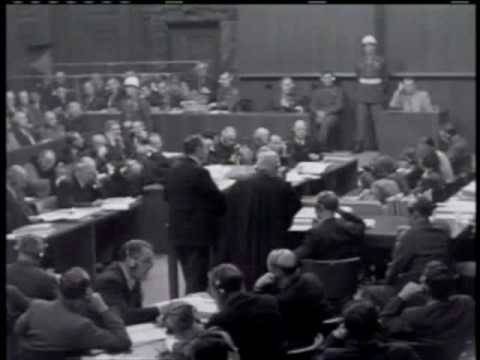
Mar 15, 1946 - Goering
During Goering’s Direct examination by his counsel, Dr. Stahmer on March 15, 1946, Robert H Jackson, Chief American Prosecutor, objected to a line of questioning. It dealt with the relevance of the introduction of the doctrine of reprisal. After Justice Lawrence’s ruling, there was a recess and a unique glimpse of an attorneys conference involving counsel from both sides.

Mar 16, 1946 - Goering
After the conclusion of the direct examination by Goering’s counsel, Dr. Stahmer, Goering was questioned by 14 Defense Counsel other than his own. The testimony covered March 16 and 18, 1946. In this excerpt, Walter Funk’s counsel asks about Funk’s role. Thereafter, Von Ribbentrop’s counsel, Dr. Horn, questions Goering concerning his client’s role as Foreign Minister after Feb. 1938. “Foreign policy above all was the Fuehrer’s own realm”. Thereafter, Robert H. Jackson commenced his much anticipated cross examination.
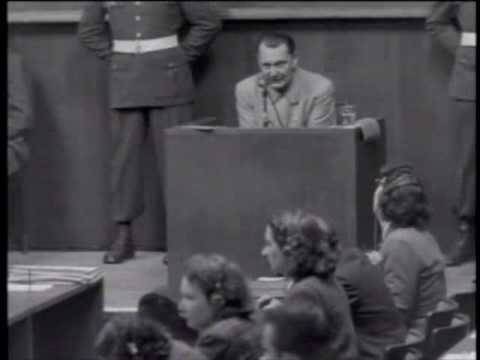
Mar 18, 1946 - Cross Examination of Goering III
On March 18, 1946, the long awaited cross examination of Hermann Goering by chief American Prosecutor Robert H. Jackson commenced. these are highlights of the first of three days of examinations.
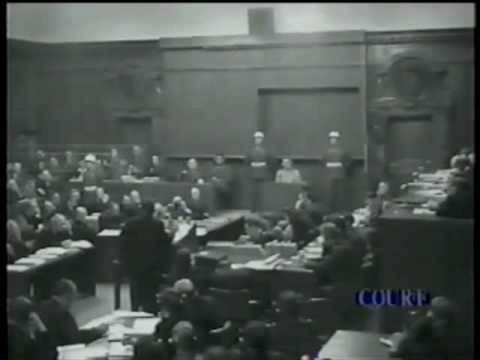
Mar 18, 1946 - Cross Examination of Goering II
This is a continuation of the cross-examination by Robert H Jackson of lead defendant Hermann Goering on March 18, 1946. The testimony covered the leadership principle’s of Hitler, his policy to never negotiate and the continuing loyalty of his closest officials.

Mar 18, 1946 - Cross Examination of Goering I
On March 18, 1946, Robert H Jackson, Chief American Prosecutor, cross-examined lead defendant Hermann Goering. He began by noting that “You are perhaps aware that you are the only living man who can expound to us the true purposes of the Nazi party and the inner working of its leadership?” Goering responded: ” I am perfectly aware of that.”
The testimony concerned the methods of the Nazi rise to power, its methods in sustaining power , the Roehm affair, the creation of the SA, SS and other security measures.
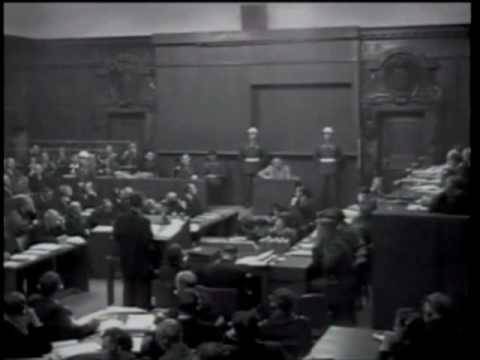
Mar 19, 1946 - Dahlerus (with translation)
On March 19, 1946, Dr. Otto Stahmer called Swedish businessman, Birger Dahlerus, to the stand as part of the defense of Hermann Goering. This vignette shows the translators in action as Dahlerus testied regarding Germany’s desire to come to an understanding with Great Britain on the Poland affair. Dahlerus had a meeting with Lord Halifax at the insistence of Goering.

Mar 19, 1946 - Dahlerus
This is an excerpt from testimony of Birger Dahlerus, a Swedish businessman. He was called by Dr. Stahmer during cross-examination of Goering. Dahlerus testified about his action as a go-between shortly before the German invasion of Poland on Sept. 1, 1939.He said he informed Goering that public opinion in Great Britain was now extremely bitter and was resolved to make no more concessions. Goering, Dahlerus testified, had said that he would do everything in his power to prevent war.
This excerpt is remarkable by not what was said but as an example of how the various translators were used as the film operator changes from language to language throughout the clip.

Mar 20, 1946 - Cross Examination of Goering by British Prosecutors
On March 20-21, 1946, Sir David Maxwell- Fyfe, Chief Deputy Proecutor of the British Delegation followed Robert H jackson in cross-examining Hermann Goering. Nearly half of his examinationwas devoted to the murder of the fifty British flyers who escaped Stalag Luft III. On the extermination policy, Goering answered: “As far as Hitler is concerned, I have said I do not think so. As far as I am concerned, I have said that I did not know, even approximately, to what extent these things were taking place.”

Mar 20, 1946 - Jackson & Lawrence on Goering’s Answers
On March 20, 1946, Robert H Jackson argues various points with Chief Justice Sir Geoffrey Lawrence regarding the length of Goering’s response to cross examination questions. Jackson shows his displeasure with the ruling which permits Goering to elaborate on his answers to Jackson’s questions.

Mar 20, 1946 - Jackson & Lawrence
On March 18,1946, Robert H Jackson, Chief American Prosecutor, began the session with a legal argument with Sir Geoffrey Lawrence, President Judge of the Tribunal, regarding the previous day’s questioning of Goering where he said he did not recall the United States publicizing its mobilization plans. Jackson worried about whether to respond to this. This lead to a debate between Jackson and Judge Lawrence concerning the rules of cross examination and the extent of the permitted response. Lawrence ruled that the defendant “may make a short explanation’ and is not confined simply to answering yes or no.
Mar 20, 1946 - Cross Examination of Goering Regarding The Treatment of Jews
Excerpts from United States government film of Justice Robert H. Jackson, the chief U.S. prosecutor before the International Military Tribunal at Nuremberg, Germany, cross-examining defendant Hermann Goering on March 20, 1946. Specific topics covered in these excerpts include: (1) Goering’s plan to eliminate Jews from Germany’s large industries; (2) Goering’s September 1935 proclamation of the Nuremberg laws; (3) Goering’s April 1938 publication of penalties for concealing Jewish participation in business enterprises; and (4) Goering’s July 31, 1941, directive regarding “solution of the Jewish question.” Regarding the last, Goering, reading from the German document, states that Jackson’s English translation of the document mistranslates “total solution” as “final solution.”

Mar 20, 1946 - Cross Examination of Goering V
On March 20. 1946, Justice Robert H Jackson, chief American Prosecutor, continued his cross-examination of the lead Defendant, Hermann Goering. There was dialog between Justice Jackson and Sir Geoffrey Lawrence regarding the ability of Goering to answer questions briefly of with explanation. Goering testified regarding preparations for the Final Solution of the Jewish Question, Heydrich’s report concerning Crystal Night and his conference on the Jewish Question.
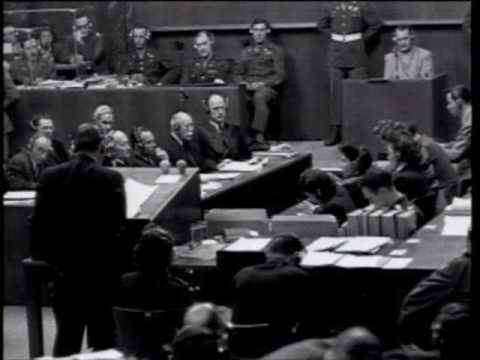
Mar 20, 1946 - Cross Examination of Goering IV
This is an excerpt of the third day of Justice Robert H Jackson’s cross-examination of lead Defendant Hermann Goering. The testimony concerned preparations for the Final Solution of the Jewish Question, Heydrich’s report on Crystal Night and Goering’s conference on the Jewish Question.

Mar 21, 1946 - Cross Examination of Goering by British & Russian Prosecutors
Following the three day cross examination of Hermann Goering by American Chief Prosecutor Justice Robert H Jackson, Britiish Chief Prosecutor Sir David Maxwell-Fyfe took the podium. Nearly half of the his examination was devoted to the murder of the fifty British flyers who escaped Stalag Luft III. This was the so-called Sagan Order ( depicted in thh film “The Great Escape”) Goering testified that the exetent of the activities at the concentration camps ” were kept a secret from me. I might add that in my opinion not even the Fuehrer knew the extent of what was going on.”
On the following day, March 21, 1946, Chief Prosecutor for the Soviet Union Roman Rudenko continued the cross examination. Goering conceded that he was the closest collaborator of Hitler on matters concerning the Air Force and economics. On invasion of Russia, he confirmed a prior statement to the troops that “you are sent there not to work for the welfare of the population, but for the purpose of extracting everything possible out of these territories.”

Mar 21, 1946 - Cross Examination of Goering by British Prosecutors II
Sir David Maxwell-Fyfe, counsel for the British Delegation followed Justice Robert H Jackson in cross examining Hermann Goering. Nearly half of the cross was devoted to the murder of the fifty British flyers who escaped from Stalag Luft III. On the concentration camps, Goering said he was ignorant on what was going on and “in my opinion, not even the Fuehrer knew the extent of what was going on.” Despite reviewing several documents mentioning the disappearance and extermination of the Jews, Goering maintained his ignorance.
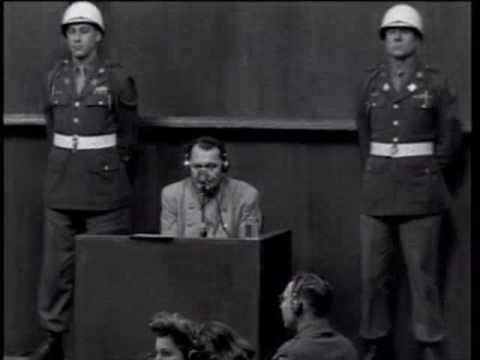
Mar 25, 1946 - Seidl & Fyfe
On March 25, 1946, Dr.Alfred Seidl, counsel for defendants Frank and Hess, sought a ruling from the Tribunal regarding the use of documents that were in a book but not read into evidence. Sir David Maxwell-Fyfe, Deputy Prosecutor for the British delegation, suggested that the Tribunal defer the decision and see how Sr. Seidl chooses to use the documents and then an argument over its evidentiary value could be considered.

Mar 28, 1946 - Schmidt
On March 28, 1946, Dr. Martin Horn, Von Ribbentrop’s Counsel, called Dr. Paul Otto Schmidt , an interpreter in the German Foreign Office who often participated in important conferences with foreign officials. He testified that the Japanese attack on America at Pearl Harbor took Ribbentrop and the entire Foreign Office by surprise. He also testifeied that when germany invaded Poland and received the Btritish ultimatium on Sept. 3, 1939, the announcement did not please Hitler of Ribbentrop.
In a conference in 1944 among Admiral Horthy, Regent of Hungary, Hitler and Ribbentrop, Horthy asked if he were supposed to beat the Jews to death. After a lull, Ribbentrop said “Yes, there are only two possibilities – either that , or to intern the Jews.”

Mar 28, 1946 - Blank
On March 28, 1946, Dr. Martin Horn, Von Ribbentrop’s Counsel, called Margareta Blank, Ribbentrop’s personal secretary from 1935 until the German collapse. She testified that Ribbentrop “always showed the greatest admiration and veneration for Adolf Hitler”. Hitler’s will was equivalent to a military order. Hitler refused several letters of resignation from Ribbentrop. Regarding any additional secret agreement between the Germans and Soviets, she stated she learned of it only through a sealed envelope which she was instructed to file separately. There was no cross-examination.

Mar 29, 1946 - von Ribbentrop
On March 29, 1946, Dr. Martin Horn, Counsel for Joachim Von Ribbentrop, Foreign Minister under Nazi Germany was called to the stand to share a summary of his early life, diplomatic relations with Great Britain, Membership in the SS and his loyalty to Hitler. Also, Hitler’s commanding role in foreign policy.

Mar 30, 1946 - von Ribbentrop III
Saturday March 30, 1946 saw the direct testimony of Defendant Joachim Von Ribbentrop, Foreign Minister of Nazi Germany. His counsel Dr. Martin Horn conducted the testimony and this excerpt, in German, deals with relationship with Greece. In addition, Dr. Seidl, asks the Defendant about Hitler’s views of Russian military strength. Finally, an excerpt from the cross examination of British Prosecutor Sir David Maxwell Fyfe regarding the military measures used in Austria.

Mar 30, 1946 - von Ribbentrop II
Dr. Martin Horn, Counsel for Joachim Von Ribbentriop, the foreign minister of Nazi Germany throughout the period when the Nuremberg defendants were charged with aggression called his client to the stand on March 30, 1946. He testified about early life, diplomatic relations with Great Britain and France, membership in the SS and party loyalty, Hitler’s commanding role and the German-Soviet Non-Aggression Pact.
This segment also shows Dr. Seidel, Counsel for Hess, asking about the Secret protocol attached to the Non-Aggression Pact with the Soviet Union. He concluded that if the Protocol “is considered an aggression, then both sides are guilty for it.”

Apr 02, 1946 - von Ribbentrop IV
On April 2, 1946, Sir David Maxwell-Fyfe of the British Delegation cross-examined Von Ribbentrop, the Nazi Germany Foreign Minister. It was deemed one of the most striking cross-examinations of the Trial enhanced by the Allies having a large number of captured documents. Subjects discussed included the mater of pressure on the Austrian Chancellor Schuschnigg; admissions of the threat of force in Czechoslovakia; treatment of the Yugoslav partisans and relations with Great Britain.

Apr 03, 1946 - Keitel
April 3-6,1946 saw the testimony of Defendant Wilhelm Keitel, Chief of the High Command of the Armed Forces (OKW). The direct examination was conducted by his attorney Dr. Otto Nelte who tried to show that Keitel was a soldier above all. He was cross examined by Russian chief counsel General Roman Rudenko regarding his relationship with Hitler. Sir David Maxwell-Fyfe next cross examined Keitel regarding treatment of prisoners of war.
Apr 08, 1946 - Lammers II
On April 8, 1946, Dr. Seidl, Counsel for Hess, cross-examined Hans Lammers, Chief of the Reich Chancellery, why Hitler had appointed Hess Deputy to Hitler in the Nazi party and also a Reich Minister. Lammers replied: ” He appointed Hess Deputy to the Fuehrer, I believe, because he, as Chancellor of the Reich, no longer wanted to attend to the business of the party and have a responsible man for the technical leadership of the Party. He appointed hess in order to have a link between Party and State.

Apr 08, 1946 - Lammers I
Dr. Seidl, counsel for Frank and Hess, called Hans Lammers, former Chief of Staff of the Reich Chancellery, to the stand on April 8, 1946. He testified that Hitler felt free from the bonds of the Treaty of Versailles. He also explained why he choose Rudolf Hess as his deputy.

Apr 09, 1946 - Dispute of Documents
On April 9, 1946, Justice Jackson charged that Dr. Thoma, counsel for Rosenberg, had requested the translation of documents which had not been approved by the Tribunal. Tensions arose regarding whether Dr. Thoma was trying to print anti-semitic quotes for the record. President Lawrence said an error had been made and with the help of Dr. Dix, counsel for Schacht, emotions were tempered.

Apr 10, 1946 - Wielen
On April 10, 1946, British Prosecutor G. D. Roberts called Max Wielen, Senior Government Counsellor of the Criminal Police (Kripo) at Breslau. He was interrogated regarding the order to shoot escapees of the Stalag Luft III (Sagan Order).

Apr 11, 1946 - Kaltenbrunner II
On April 11, 1946, Dr. Kauffmann called his client, Defendant Ernst Kaltenbrunner on the stand. In German, Kaltenbrunner talked about a Bullett Decree meaning a Fuehrer Order. An additional scene is Kaltenbrunner awaiting a ruling from the Court. Cross examination took place the next day.

Apr 11, 1946 - Kaltenbruner I
On April 11, 1946, The defendant Ernst Kaltenbruner, Chief of the Security Police and SD and Head of the Reich Security Main Office, was called to the stand by this counselor, Dr. Kurt Kuaffmann. He started his testimony by saying that “I know the hatred of the world is directed against me; that I particularly since Himmler, Mueller and Pohl are no longer alive must here , alone, give an account to the world and the Tribunal.”
In this excerpt form Court TV’s ten hour documentary on the Nuremberg Trial, we see the cross-examination conducted by Colonel John Amen of the American Delegation. Amen confronted Kaltenbruner on a number of affidavits that he was at concentration camps and he denied knowledge and attendance. at death camps. He even denied his signature on orders from him.

Apr 12, 1946 - Kaltenbrunner III
On April 12, 1946, Col. John Amen of the Americn Delegation cross-examined Kaltenbrunner. He was confronted regarding concentration camps by an affidavit stating he had visited Mauthausen Concentration Camp and had witnessed gassing. He denied this. He denied his signature on Orders and maintained that everything was ordered the Reich Security Office, Himmler or Heydrich.

Apr 15, 1946 - Hoess (Amen)
Following the direct examination by Ernst Kaltenbruner’s Attorney Kauffmann of Rudolf Hoess, the former commandant of Auschwitz, Colonel John Amen, Chief of the Interrogation Division of the American Prosecution, cross examined Hoess. Amen read from an affidavit that Hoess had given to the American Prosecution ten days earlier. The affidavit contained information on the number and makeup of the persons who died a t Auschwitz (2,500,000-3,000,000), the organizations responsible for the mass executions (RSHA), the fact that the term “final solution” referred to the complete extermination of Jews in Europe and thge methodology of the executions.

Apr 16, 1946 - Rosenberg
April 16-17, 1946 saw the defense of Defendant Alfred Rosenberg by his counsel Dr. Alfred Thoma. In this excerpt, Rosenberg, in German, describes the decree creating the Ministry for the Occupied East which named him as Minister and its functions.
In cross examination, Thomas Dodd, Executive Trial Counsel for the American Delegation, elicited the facts about the well-known forced labor program.

Apr 18, 1946 - Frank
April 18, 1946 saw Dr. Seidl call his client, Hans Frank, Nazi lawyer and Governor General of Occupied Poland to the stand. In this excerpt, Frank describes his principal positions in the Nazi Party and Hitler’s government.
After the Nazi defeat, Frank turned over his elaborate diary to the Allied authorities and this diary became a prime source of evidence in the Trial.

Apr 23, 1946 - Buehler
Dr.Seidl, the attorney for the Defendant Frank called his last witness, Joseph Buehler on April 23, 1946. Buehler had worked for Fank from March 1933 until the German collapse. Seidl read an extract from Frank’s diary which mentioned the witness. “My attitude towards the Jews is based on the expectation that they will disappear; they must go away”.Buehler, in German, talked about the resettlement policy.

Apr 24, 1946 - Direct Examination of Gisevius
On April 24, 1946, Dr. Rudolf Dix, Counsel for Hjalmar Schacht, called Hans Gisevius, known for his resistance. He testified that Schacht collaborated with him in obtaining information against the Gestapo and SS. Despite his early support for Hitler, Gisevius stated that in 1935 Schacht steadily withdrew from the Nazis.

Apr 26, 1946 - Streicher
This vignette deals with the direct examination of Defendant Julius Streicher by his counsel Dr. Hanns Marx on April 26,1946. Because Streicher was not happy with Dr. Marx, he asked the Tribunal to remove him. The Tribunal reassured Streicher that the Tribunal would see to it that everything relevant and material to his case would be presented. Similarly, Judge Lawrence assured Dr.Marx “that he should proceed with the case.”
Streicher then gave a long and quite coherent description of his career. Note the exasperation on Dr. Marx’ s face.

Apr 26, 1946 - Robert H. Jackson & Gisevius
Justice Robert H Jackson conducted the cross examination of Hans Gisevius, A member of the Abwehr, the German counter-intelligence service under Admiral Canaris. Justice Jackson asked a number of questions bearing on the charge that the Gestapo was a criminal organization. The cross examination took place on April 24, 1946.

Apr 30, 1946 - Schacht
On April 30, 1946, Dr. Rudolf Dix, counsel for defendant Hjalmar Schacht, called his client to the stand. Schacht testified as to his first meeting with Hitler, his attitude on the Jewish Question and his changing attiute toward Hitler. Schacht was on the stand for 4 days.

May 02, 1946 - Cross Examination of Schacht
Justice Robert H Jackson conducted the cross examination of Hjalmar Schacht, the former Nazi Minister of Economics on May 2,1946. Schacht was later acquitted of all charges.

May 02, 1946 - Robert H. Jackson & Schacht
On May 2, 1946, Robert H Jackson, Chief Counsel for the American Delegation, cross examined Defendant Hjalmar Schacht, President of the Reichsbank and Reich Minister of Economics. Justice Jackson cross-examined Schacht for more than one-half day. Jackson pressed him to identify the criminals of the Regime. He named Hitler, Himmler, Goering, Borman, von Ribbentrop and Heydrich. Jackson confronted Schacht with a number of photographs which place Schacht with those criminals. t was a memorable moment in the Trial.

May 03, 1946 - Funk
On May 3, 1946, Walter Funk, Reich Minister of Economics and President of the Reichsbank, was called to the stand by his attorney Dr. Fritz Sauter. Some of the cross-examination of Funk is among the fascinating episodes of the Trial.
In this excerpt from Court TV’s 10 hour documentary on the Nuremberg Trial, Dr. Sauter’s direct examination followed by the cross-examination by American Prosecutor Thomas Dodd. A highly significant issue in Funk’s case was what he knew about certain deposits which the SS made in the Reichsbank including deposits of gold from concentration camp inmates (gold dentures).

May 04, 1946 - Direct Examination of Funk (In English)
May 4, 1946, testimony of Defendant Walter Funk on direct examination by his counsel, Dr. Fritz Sauter, Through an English translator, we hear Funk testify about the Fuehrer’s Principle and its application to the German people.

May 04, 1946 - Direct Examination of Funk
On May 4, 1946, Defendant Walter Funk was examined by his counsel, Dr. Fritz Sauter. The testimony concerned the Fuehrer Principle and its application to the German people. Also, how he met Hitler.

May 08, 1946 - Direct Examination of Doenitz (In English)
This segment is part of the first day of testimony of Defendant Karl Doenitz, Commander-in-Chief of the Navy. It was conducted by his Counsel, Dr. Otto Kranzbuehler. He testifies through a translator in English about U-boats and his political career. This segment occurred on May 8, 1946.

May 08, 1946 - Direct Examination of Doenitz
The case of Karl Doenitz, commander of the Submarine Arm of the Navy and Commander-in-Chief of the Navy, was conducted by his Counsel, Dr. Otto Kranzbuehler. Early testimony in German developed the fact that Doenitz had perfected the “wolf pack tactics” for U-boats. Doentz agreed the labeling U-boats as an aggressive weapon but stated that it does not mean that it was a weapon for an aggressive war. The tactics were received from Admiral Raeder. He also tried to explain his order to his German submarine commanders: “Do not rescue any men; do not take them along; and do not take care of any boats of the ships…. Concern yourself only with the safety of your own boat and with efforts to achieve success as soon as possible. We must be hard in this war.” This segment was from testimony on May 8, 1946.

May 08, 1946 - Doenitz
On May 8, 1946, Dr. Otto Kranzbuehler, former Fleet Judge of the German Navy, called his client, Karl Doenitz, Commander of the Submarine Arm of the Navy and Commander-in-Chief of the Navy to the stand.Durng his testimony Doenitz said his mission was “to be prepared against all was emergencies”. U-boats was an aggressive weapon but that did not mean it was a weapon for an aggressive war.
This segment from Court TV’s documentary of the Nuremberg Trial also show the cross-exam of Doenitz by Sir David Maxwell-Fyfe of the British Delegation.Doenitz denied knowledge of the Extermination of the Jews and Conditions in the Concentration Camps.

May 10, 1946 - Doenitz II (In English)
The principal cross-examination of Karl Doenitz was conducted by Sir David Maxwell-Fyfe of the British Delegation. This May 10, 1946 segment deals with the orders of Admiral Doenitz concerning responsibility to the seamen in boats after the sinking of their ship. His response is translated into English.

May 10, 1946 - Doenitz II
On May 10, 1946, the principal cross-examination of Karl Doenitz was conducted by Sir David Maxwell-Fyfe of the British Delegation. Subjects covered included positions of Doenitz after January 1943 when he became Commander-in-Chief of the Navy, denial of knowledge of the concentration camps, use of foreign worker and the laws concerning Submarine warfare.

May 15, 1946 - Puhl
During the Case of Walter Funk, President of the Reichsbank, the American prosecutor Thomas Dodd introduced the affidiavit of Emil Puhl, its Vice President. The purpose of the affidavit was to indicate that Puhl had informed Funk of the nature of the deposits from the inmates of the concentration camps. This excerpt shows Dr. Sauter, Funk’s counsel, cross examining Puhl with regards to his affidavit.

May 15, 1946 - Thoms
On May 15, 1946, Thomas Dodd, American prosecutor, called Albert Thoms to the stand. He had worked in the vaults of the Reichsbank as a Councillor. He testified regarding the deliveries to the Bank of gold, silver, jewelry, pearls and pearl necklaces. This testimony was part of the Funk presentation. He also testified regarding the Melmer affair and Vice President Puhl.

May 23, 1946 - von Schirach II
On May 23, 1946, the defense case of Baldur Von Schirach was commenced by his counsel, Dr. Fritz Sauter calling him to the stand. Von Schirach was the Hitler Youth Leader and Gauleiter of Vienna. The defendant testified about how he got involved and how the Youth Group functioned.
Thomas Dodd, American prosecutor, cross examined Von Schirach on May 24, 1946. He asked about songs included in the song book of the Hitler Youth. One spoke of the Jews as traitors who enslaved misguided people.

May 23, 1946 - von Schirach I
On May 23, 1946, Dr. Fritz Sauter called his witness defendant Baldur von Schirach, Hitler Youth Leader, to the stand. You hear the testimony through an English translator. Following the direct examination is the cross examination conducted by Thomas Dodd, Deputy U.S.Prosecutor.

May 27, 1946 - Lauterbacher
On May 27, 1946, Dr. Sauter called Hartman Lauterbacher, Stabsfuehrer of the Reich Youth Leadership, responsible to Von Schirach. In German, He explained his role.

May 28, 1946 - Wieshofer
On May 28, 1946, Dr. Sauter, Counsel to Baldur Von Schirach, called to the stand Von Schirach’s adjutant, Fritz Wieshofer. He testified, in German, about the forced evacuations of Jews from Vienna and the procedures used for resettlement.

May 29, 1946 - Sauckel II
On May 28-29, 1946, Dr. Robert Servatius called Fritz Sauckel, the Plenipotentiary General for the Utilization of Labor, to the stand. His case concerned the charges of slave labor. He held honorary rank of Obergruppenfuehrer in both the SA and the SS. He briefly talks about the difficulty of meeting the demands of the Central Planning Board.
He is cross examined by M. Jacques Herzog, a French Prosecutor, on his Nazi party affiliation and loyalty to Hitler.

May 29, 1946 - Sauckel I
On May 29. 1946, the defendant Fritz Sauckel, Plenipotentiary Genreral for the Utilization of Labor, was called to the stand by his counsel, Dr. Robert Servatius. Ironically, Dr. Sevatius would represent Adolf Eichmann in his Trial in Jerusalem in 1961.
Sauckel testified that Hitler’s appointment as him as Plenipotentiary General for Labor Utilization came as a complete surprise.
Thomas Dodd, American Executive Counsel, questioned Sauckel about minutes of a meeting in April 1942 when he reportedly said”the Russians will have to be handled so roughly by the German administration n the East that they will prefer to go to Germany rather than say in Russia”.
Jun 04, 1946 - Jodl II
A June 4, 1946 excerpt from the questioning by Dr. Exner of Defendant Alfred Jodl on the case of the 2nd SS Panzer Division and whose responsibility to control.

Jun 04, 1946 - Jodl I
On June 4, 1946, Dr. Hans Exner, Jodl’s Counsel, called him to the stand to explain his relationship to Keitel. He stated, in German, that he was chief of one of the many departments subordinate to Keitel. He did not have authority to issue orders. The Defendant Jodl was Chief of the Operations Staff of the OKW and reported to Keitel and Hitler.

Jun 04, 1946 - Dr. Jaeger
This is an excerpt from witness, Dr. Wilhelm Jaeger, the senior camp director for foreign workers at the Krupp concern in Essen. The examination is conducted by Dr. Robert Servatius, counsel for Fritz Sauckel. He testifies as to his relationship with Krupp and the German Labor Front. the testimony occurred on June 3, 1946.

Jun 06, 1946 - Cross Examination of Jodl II
On June 6, 1946, British prosecutor, G.D. Roberts, cross examined defendant Alfred Jodl on the Hossbach Conference (1937) and his understanding of its significance leading to war.
Jun 06, 1946 - Cross Examination of Jodl I
This is an excerpt from the cross examination of Alfred Jodl by British prosecutor ,G.D. Roberts on June 6, 1946. Mr. Roberts questions are followed by Jodl’s response(off camera) in German. Areas of interest were the Hossbach Conference, invasion of Czechoslovakia and the Operation Otto Order.
Jun 06, 1946 - Jodl III
On June 6, 1946, G.D. Roberts, of the British Delegation cross examined Defendant Alfred Jodl. He questions regarding the Sagan order regarding the killed British air men and his feelings towards Hitler thereafter.

Jun 10, 1946 - Seyss-Inquart
On June 10, 1946, Dr. Gustav Steinbauer called the Defendant Arthur Seyss-Inquart, Administrator of three German Occupied Countries to the stand. He controlled Austria, Poland and the Netherlands. In German, Seyss-Inquart testifies regarding his early memberships. The sound is not good but gives you a sense of this Defendant.

Jun 12, 1946 - Rainer
On June 12, 1946 during the defense case of Arthur Syss-Inquart, Administrator of Occupied Austria, Poland and the Netherlands,his counsel called Friedrich Rainer, Gauleiter of Salzberg and later Carinthia. Rainer testified regarding Seyss-Inquart and the Austrian leader Schushnigg relationship which lead to the Austrian expansion. The testimony in this excerpt is translated in English.

Jun 18, 1946 - von Papen
On June 18, 1946, Sir David Maxwell-Fyfe, Deputy Chief prosecutor of the British Delegation conducted the only cross examination of Von Papen. The Defendant was Vice Chancellor of Germany and German Minister to Austria until 1938 and thereafter Ambassador to Turkey. This excerpt finds Von Papen, in German, trying to explain the early rise of Hitler and his possible role.

Jun 19, 1946 - Speer I
On June 19, 1946, Defendant Albert Speer, Reich Minister for Armaments and War Production, was called to the stand by his counsel, Dr. Flaechsner. Speer had been a close friend and confidant to hItler since 1934. Under direct examination, Speer denied responsibility for recruiting manpower saying “neither I nor my Ministry was responsible for this recruitment. He said that his Ministry collected the demands for labor from industries subordinate to it without specification as to whether the laborers be German, foreign workers, or prisoners of war.”
Justice Robert H Jackson conducted the first and by far the longest cross-examinations of Speer. It was one of the highlights of the Trial. He conceded that the Nazis were anti-semitic and the Jews were being evacuated from Germany. He acknowledge that there was a deportation of 100,000 Jews from Hungary.

Jun 20, 1946 - Speer II
June 20, 1946 saw the beginning of the defense case on behalf of Albert Speer, Reich minister for Armaments and War Production. Dr. Hans Flachsner, Speer’s counsel, elicits testimony, in German, concerning his disagreements with Sauckel and his attempts to assassinate Hitler.

Jun 21, 1946 - Cross Examination of Speer
Justice Robert H Jackson conducted the first and by far the longest cross examination of Albert Speer on June 21, 1946. Albert Speer was the Reich Minister for Armaments and Munitions.

Jun 25, 1946 - von Neurath
On June 25, 1946, Constantin von Neurath, Reich Foreign Minister and Rich Minister of Bohemia and Moravia, was cross-examined by Sir David Maxwell-Fyfe, Deputy Chief Prosecutor of the British Delegation.In August 1940, nearly a year and a half after von Neurath became Protector of Bohemia and Moravia, he wrote a letter of Dr. Lammers, head of the Reich Chancellery, a letter on the future organization of Bohemia and Moravia. The letter outlined the Germanization and treatment of the natives.
Judge Biddle questioned his relationship with Himmler and Judge Nikitchenko was interested in whether the Defendant had ever publicly expressed any disagreements with Hitler’s policies. von Neurath replied:”No. It was not longer possible either to have a voice in the press… any more than in Russia.”

Jun 26, 1946 - Fritzsche
On June 26, 1946, Hans Fritzsche was called to the stand by his counsel Dr. Heinz Fritz. Fritzsche was head of the Home Press Division and Chief Radio Proagandist. In German, he testified on his motivation and attitude towards the Nazis. Also, his disdain for Streicher’s Der Sturmer. iThe cross-examination was conducted entirely by General Roman Rudenko, the Soviet Chief Prosecutor, who focused in this segment with the relationship between the Ministry of Proaganda and the Ministry of Foreign Affairs. He also spoke of Kaltenbrunner, Hess and Goebbels.

Jun 26, 1946 - Kopke
On June 26, 1946, Dr. Otto von Ludinghausen, counsel for Constantin von Neurath, called former Ministerial Director in the German Foreign Ministry, Dr. Gerhard Kopke to the stand.He testified von Neurath repeatedly tried to exercise his moderating and calming influence on the Party.

Jul 01, 1946 - Bazilevsky on The Katyn Massacre
On July 1, 1946, Consellor Smirnov called the frist of three witnesses regarding the Katyn Masacre. Boris Bazilevskzy, former deputy mayor of the city of Smolensk during the German occupation, testified that before the German occupation there were Polish prisoners of warworking on roads. He testified that early Sept. 1941, there was “talk” to exterminate the Poles. Two weeks later, he said the Poles had been shot. Uopn cross, he said he had not seen the burial grounds as the Germans had denied access.

Jul 01, 1946 - Ahrens on The Katyn Massacre
On July 1, 1946, Counsellor Smirnov, Russian prosecutor, cross examined Colonel Friedrich Ahrens, the commanding officer of Signal Regiment 537. On direct exam by Dr. Stahmer, he said that during 1942 his soldiers state that shootings were supposed to have taken place in the Katyn Forest. Upon cross, Ahrens said he had not been there during September and October 1941. He had seen the graves in 1943 and the graves had been open. He never prepared a report.

Jul 02, 1946 - Nimitz & Doenitz
This segment from the Court TV documentary on the Nuremberg Trial anchored by Fred Graham shows the cross examination of Defendant Karl Doenitz, Commander-in-Chief of the Nazi Navy, by Sir David Maxwell-Fyfe.The subject was certain Orders issued by Doenitz regarding rescue: “Do not rescue any men; do not take them along; and do not take care of any boat of the ship….”
To counteract this evidence, Doenitz’s defense counsel, Dr. Otto Kranzbuehler obtained the permission of the Tribunal obtain an interrogatory from U.S. Admiral Chester Nimitz, Commander-in-Chief of the U.S. Pacific Fleet.
On July 2, 1946 Dr. Kranzbuehler offered the Nimitz answers into evidence . It was cruciall testimony for Doenitz..

Jul 05, 1946 - Closing Statement For von Ribbentrop
On July 5, 1946, Dr. Martin Horn, counsel for Joachim von Ribbentrop, presented his final arguments on behalf of his client. The presentation is in German.

Jul 09, 1946 - Keitel
This is an excerpt of the closing remarks, in German, by Defendant Wilhelm Keitel’s counsel on July 9, 1946. Dr.Otto Nelte tried to show that the SS and Police organizations influenced the conduct of the war and how the Wehrmacht was drawn into events. He tried to minimize Keitel’s direct knowledge of the effects of the Fuehrer’s “Night and Fog” decree.

Jul 12, 1946 - Streicher
On July 12, 1946, Dr. Hermann Marx, Counsel for Julius Streicher presented the closing argument on behalf of his client. In German, Dr. Marx’s principal argument was a question of causation. Marx readily admitted that Streicher had preached hatred of the Jews and that his propaganda made the Jews “a scapegoat for Germany’s loss of World War I and her suffering thereafter . The question was whether Streicher actually “educated the German people to a degree of anti-Semitism” which made the Holocaust possible.

Jul 23, 1946 - Closing Statement by The Russian Prosecution
On July 29, 1946, General Roman Rudenko , the chief Soviet prosecutor, delivered the summation for the Soviet Union. His speech was four hours long. This short excerpt shows Rudenko’s call for the death penalty for all defendants. “I appeal to the Tribunal to sentence the defendants without exception to the supreme penalty-death. Such a verdict will be greeted with satisfaction by all progressive mankind”.

Jul 26, 1946 - Closing Statement by The British Prosecution
On July 26, 1946, The British Chief Prosecutor, Sir Hartley Shawcross, made the longest closing statement of the Prosecution. He began by emphasizing that Nazi Germany fought a “total and totalitarian war” in defiance of solemn agreement and treaties. He said ten million had been killed “in battles that ought never to have been,” and that 12 million more persons had been murdered during the Nazi occupation of invaded countries, including two-thirds of all European Jews.
He declared that all major actions by the Nazi leaders were related to preparation for watr. In this excerpt, he quotes extensively from the affidavit of Herman Graebe, a German engineer who observed one of the Einsatzgruppen executions of Jews at the airport near Dubno in the Soviet Union.

Jul 26, 1946 - Closing Statement by Robert H. Jackson
Justice Robert H. Jackson, the chief United States prosecutor, delivered his closing argument to the International Military Tribunal (IMT) at Nuremberg on July 26, 1946.
In these filmed excerpts, the scenes of Jackson in a long necktie are trial footage; the scenes of Jackson in tuxedo were filmed after hours, in the empty courtroom, for the U.S. historical record.

Jul 29, 1946 - Closing Statement by The French Prosecution
The French summation was delivered by the chief prosecutor M. Auguste Champetier de Ribes on July 29, 1946. He began by paying tribute to the disclosures of the Trial for the benefit of history. He stated that the Germans as “a great people” controlled by a small minority of criminals.
In summarizing the kinds of atrocities committed he mentioned the taking and shooting of hostages, the burning down of whole villages in France and Holland, the maltreatment of prisoner of war and forced labor.

Aug 10, 1946 - von Rundstedt
Field Marshal Gerd Von Rundstedt was called to be a principal witness in defense of the German Staff and High Command. In 1942 he became Commander-in-Chief West. In this excerpt, Von Rundstedt , in German. responds to Commander Calvocoressi’s examination regarding the invasions of Belgium, the Netherlands and Poland.
*Correction August 2023: The name of British Prosecutor Peter Calvovoressi is misspelled in his title slide in the video (1:06). For the time being and in the interest of maintaining analytics we cannot amend the video itself. We have updated the associated website, this description, and offer apologies to the Calvocoressi family and his descendants.
Aug 10, 1946 - von Manstein
On August 10, 1946, Brigadier General Telford Taylor, American Prosecutor, commenced one of the most devastating cross examinations of the Trial. The focus was Manstein’s actions as commander of the German 11th Army from Sept. 1941 until 1944. In this excerpt Taylor reads from an order of July 23, 1941 signed by Keitel. Reference was also made to the Commissar Order and a certain Order he signed. He had difficulty recalling these.
Aug 10, 1946 - Hauser
This is a short excerpt of a cross examination by Maj. Elwyn Jones of the British Delegation of SS Colonel General Paul Hauser who held several leading positions in the SS. Hauser stated that the Waffen SS and the SS were not united.

Aug 14, 1946 - Juettner
During the Defense Case against the SA, Herr Boehm, its counsel called several witnesses. The fourth was Max Juettner, the Deputy Chief of Staff of the SA. Juettner was examined for 4 straight days and on Aug. 14, 1946 was cross examined by Sir David Maxweell-Fyfe, Deputy Chief of the British Delegation. This excerpt deals with the training of the SA.

Aug 16, 1946 - Funk II
On Aug. 16, 1946 Dr. Fritz Sauter recalled his client Defendant Walter Funk to the stand to clarify his testimony regarding Oswald Pohl. He admitted that he had discussed with him the deposit of valuables in the Reichsbank. In German, Funk said he knew that the SS had thousands of members who naturally had valuables. He denied that Pohl had informed him that they were taken from Jews who died in the concentration camps.

Aug 16, 1946 - Funk I
On Aug. 16, 1946, American Deputy prosecutor , Thomas Dodd, cross examined defendant Walter Funk, President of the Reichsbank. The subject dealt with SS deposits in the Reichsbank.

Aug 29, 1946 - Accused Organizations
On Aug. 29, 1946, Thomas J. Dodd, Executive Trial Counsel, made final arguments against the Accused Organizations. He stated that the “accused organizations were the principal media by and through which these transgressions of the individual defendants were effected. He went on to state that “deprive the Nazi conspirators of these organizations and they could never have accomplished their criminal aims”.

Aug 31, 1946 - von Neurath’s Final Statement
Constantin Von Neurath had been Minister of Foreign Affairs during the first five years of the Nazi regime and was Reich Protector of Bohemia and Moravia from 1939-1941. “I stand with a clear conscience not only before myself, but before history and the German people.”

Aug 31, 1946 - Kaltenbrunner’s Final Statement
After January 1943, Kaltenbrunner had been Chief of teh Security Police and SD and head of the Reich Security Main Office (RSHA). In his final statement Kaltenbrunner once again claimed that his title inflated his real authority. He declared that he had concentrated his activites on military intelligence.

Aug 31, 1946 - Fritzsche’s Final Statement
Hans Fritzsche had been head of the Home Press Division of the Propaganda Ministry from 1938-1942. Thereafter was the head of the Radio Division of the Propaganda Ministry. Fitzsche placed great emphasis on the fact he had been deceived by Hitler.”Between these criminals and myself there is only one connection: they merely misused me in a different way than they misused those who became their physical victims.”
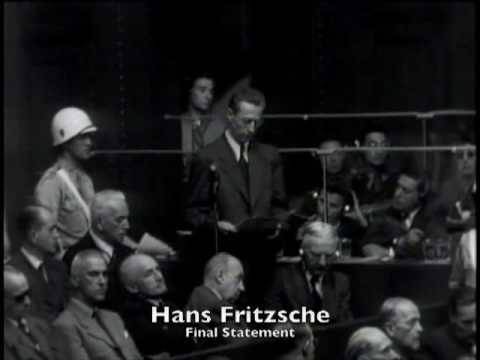
Aug 31, 1946 - von Papen’s Final Statement
Franz Von Papen, on Aug. 31, 1946, gave his final statement emphasizing that his”love of country and people was the decisive factor in all my actions. I spoke without fear of man whenever I had to speak.”

Aug 31, 1946 - Jodl’s Final Statement
The Defendant Alfred Jodl had been Chief of the Operations Staff of the High Command of the German Armed Forces. “I believe and avow that a man’s duty to one’s people and fatherland stands above every other. To carry out this duty was for me an honor, and the highest law.”
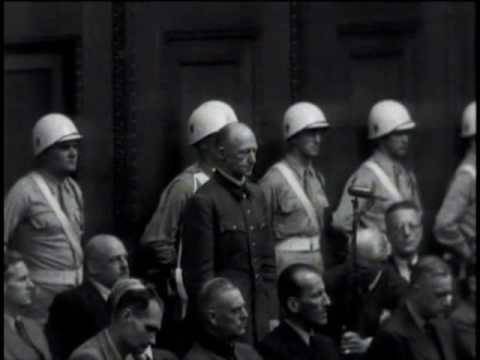
Aug 31, 1946 - Goering’s Final Statement
President Lawrence called upon the defendants in order in which they were listed in the Indictment. Reich Marshal Hermann Goering, Hitler’s designated successor, spoke first. Near the end of his presentation, Goering absolved the German people of any guilt. “The German people placed their trust in the Fuehrer, and under his authoritarian government they had no influence on events.”
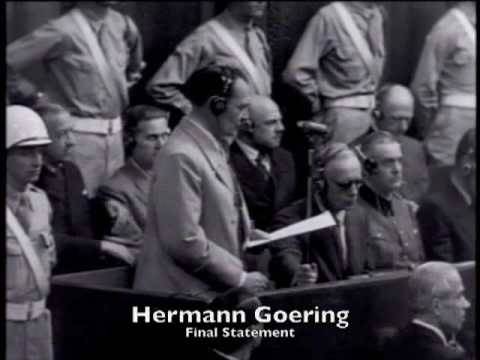
Aug 31, 1946 - Seyss-Inquart’s Final Statement
The Defendant Seyss-Inquart’s final statement was distinctive in a number of respects. He showed no contrition and did not ask for any special considerations. He considered the was “as a life-and-death-struggle for the German people.” On Hitler, “to me he remains the man who made Greater Germany a fact in German history. I served this man. And now? I cannot say crucify him since yesterday I cried “Hosanna’.”
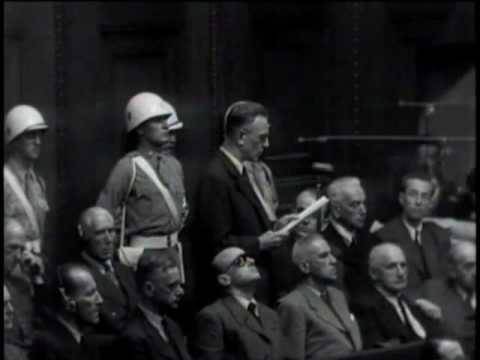
Aug 31, 1946 - Sauckel’s Final Statement
Fritz Sauckel, Gauleiter and Plenipotentiary for the Utilization of Labor, summarized his defense, in German, be emphasizing his humble social background, his empathy for workers, his commitment to Hitler, his efforts to secure good treatment for all workers and his surprise at the revelations of evil during the Trial.

Aug 31, 1946 - Closing Statement of The Defense
On Aug. 31, 1946, each of the Nuremberg Trial Defendants had the opportunity to present to the Tribunal its Final Statements. In this segment, portions of the final statements from Goering, Ribbentrop, Keitel, Kaltenbruner and Speer are shown.
After the final statement by Fritzche, the Tribunal adjourned to deliberate on the Judgments which would be delivered on Sept. 30-Oct. 1, 1946.
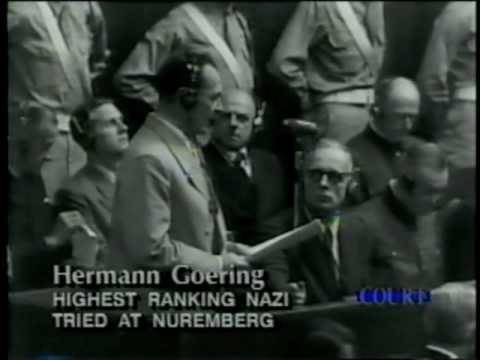
Aug 31, 1946 - von Ribbentrop’s Final Statement
On Aug. 31, 1946, Von Ribbentrop sought to make a broad justification of Nazi foreign policy. Further,”I deplore the atrocious crimes which became known to me here and which besmirch this revolution” of the Nazis. “The only thing of which I consider myself guitly before my people-not before this Tribunal- is that my aspirations in foreign policy remained without success”.
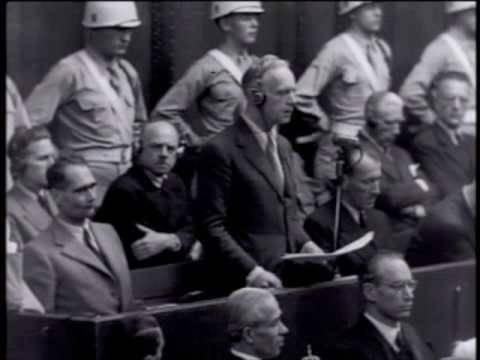
Aug 31, 1946 - Keitel’s Final Statement
On August 31, 1946, Wilhelm Keitel gave his final satement. “It is tragic to have to realize that the best I had to give as a soldier, obedience and loyalty, was exploited for purposes which could not be recognized at the time, and that I did not see that ther is a limit set for a soldier’s oeformance of his duty. That is my fate.”
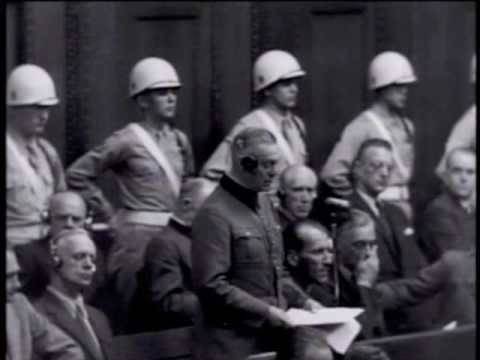
Aug 31, 1946 - Speer’s Final Statement
On August 31, 1946, the Defendant Albert Speer, the Reich Minister for Armaments and Munitions gave his Final Statement. His statement throughout emphasized the danger of dictatorship in an age of great technological development. He uttered not on word in his own defense.

Aug 31, 1946 - Hess’ Final Statement
Hess’ final statement on Aug. 31, 1946 was the longest made by any of the 21 defendants in the dock. Hess asked for permission to remain seated. At times he rambled but at the end said “I was permitted to work for many years of my life under the greatest son whom my people has brought forth in it s thousand-year history….I do not regret anything.”

Sep 30, 1946 - Reading of The Judgment Against The SS
President Judge Geoffrey Lawrence reads the Judgments against the SS organization on Sept. 30, 1946.
Sep 30, 1946 - Reading of The Judgment of The Tribunal by Judge Nikitchenko
Russian Judges of the Nuremberg Tribunal (Nikitchenko and Volchkov) reading the Judgments on Sept. 30, 1946. The Soviets dealt with slave labor and Nazi organizations.

Sep 30, 1946 - Reading of the Judgment of the Tribunal by Judge Biddle II
On Sept. 30, 1946, American Judge Francis Biddle reads that portion of the Judgment regarding the conspiracy charge.

Sep 30, 1946 - Reading of The Judgment of the Tribunal by Judge Biddle I
On Sept. 30, 1946, American Judge Francis Biddle read that portion of the Judgments relating to the conspiracy charge.

Sep 30, 1946 - Reading of the Judgment of The Tribunal by Judges de Vabres and Falco
On Sept. 30, 1946 French Judges Donnedieu de Vabres and Robert Falco read that portion of the Judgments relating Germany’s aggression, country by country.

Sep 30, 1946 - Reading of The Judgment of The Tribunal by Judge de Vabres
On Sept. 30, 1946, French Judge Donnedieu de Vabres reads that portion of the Judgment regarding German aggressions, country by country. Following the reading a recess occurs.

Sep 30, 1946 - Reading of The Judgment of The Tribunal by Judge Birkett
Judge Norman Birkett on Sept. 30, 1946 reads a portion of the Judgment at the Nuremberg Trial ( 1945-1946) relating to the Nazi’s rise to power.

Sep 30, 1946 - Reading of The Judgment of The Tribunal IV
On Sept. 30, 1946 Judges Lawrence and Birkett read portions of the Judgments at the Nuremberg Trial.

Sep 30, 1946 - Reading of The Judgment of The Tribunal III
Sir Geoffrey Lawrence reads a portion of the Judgment at the Nuremberg Trial (1945-1946).

Sep 30, 1946 - Reading of The Judgment of The Tribunal II
On Sept. 30, 1946, Sir Geoffrey Lawrence reads a portion of the Judgment as it relates to sanity of Hess to stand trial.

Sep 30, 1946 - Reading of The Judgment of The Tribunal by Judge Lawrence I
On Sept. 30, 1946, Sir Geoffrey Lawrence, President Judge, commenced the reading of the Judgment of the Tribunal to a packed courtroom. All of the members and alternate members of the Tribunal participated in the reading which lasted over one and one half days.The Judgment began by describing the foundations of the Tribunal, the scope of the proceedings and the kinds of evidence.

Sep 30, 1946 - Judgments
These are vignettes of all 8 Judges reading portions of the Judgment at Nuremberg on Sept. 30, 1946.

Oct 01, 1946 - Adjournment
This is a scene of the Tribunal’s Adjournment following the announcement of the Verdicts in the morning session of Oct. 1, 1946. 19 were found guilty and three were acquitted. The afternoon session would be the announcements of the sentences.

Oct 01, 1946 - Acquittals
On Oct. 1, 1946, three defendants were acquitted of all charges in the Indictments served them at the Nuremberg Trial: Hjalmar Schacht, Franz von Papen and Hans Fritzsche. This scene show the adjournment and the defendants reacting to the Verdicts

Oct 01, 1946 - Reading of the Judgment Against Baldur von Schirach
On Oct. 1, 1946, Baldur von Schirach, Hitler Youth Leader until 1940 and then Gauleiter and Reich Governor of Vienna was found guilty and sentenced to twenty years.

Oct 01, 1946 - Reading of The Judgment Against Martin Bormann
On Oct. 1, 1946, Martin Borrman, in absentia,The Chief of Staff in the Office of the Fuehrer’ Deputy and Head of the Party Chancellery, was found guilty on two counts and sentenced to death by hanging. It was subsequently learned Bormann had died in Berlin in 1946.

Oct 01, 1946 - Reading of The Judgment Against Hans Fritzsche
On Oct. 1, 1946, Hans Fritzsche, head of the Home Press Division of the Propaganda Ministry, was found not guilty on all four counts and freed.

Oct 01, 1946 - Reading of the Judgment Against Constantin von Neurath
On Oct. 1, 1946, Constantin von Nurath, the Reich Minister for Foreign Affairs for the first 5 years of its regime, was found guilty on all 4 counts and sentenced to fifteen years imprisonment.

Oct 01, 1946 - Reading of The Judgment Against Albert Speer
On Oct. 1, 1946, Albert Speer, Hitler’s architect and Reich Minister for Armaments and War Production, was found guilty of two counts and sentenced to 20 years imprisonment.

Oct 01, 1946 - Reading of The Judgment Against Hans Frank
On Oct. 1, 1946, Hans Frank, Reichsleiter of the Nazi Prty in charge of Legal Affairs, a Reich Minister without Portfolio and and honorary Obergruppenfuehrer in the SA, was found guilty on three counts and sentenced to death by hanging.

Oct 01, 1946 - Reading of The Judgment Against Hjalmar Schacht
On Oct. 1, 1946, Hjalmar Schacht, once President of the Reichsbank, Reich Minister of Economics and Plenipotentiary General for War Economy, was acquitted on all 4 counts and set free.

Oct 01, 1946 - Reading of The Judgment Against Ernst Kaltenbrunner
On Oct. 1, 1946, Ernst Kaltenbrunner, head of the SS in Austria in 1935 and in 1943 Chief of the Security Police and SD and Head of the Reich Security Office (RSHA), was found guilty on two counts and sentenced to death by hanging.

Oct 01, 1946 - Reading of The Judgment Against Karl Doenitz
On Oct. 1, 1946, Karl Doenitz, Comander-in-Chief of the German Navy from 1943 and previously leader of the U-boat Arm of the Navy, was found guilty on two counts and sentenced to ten years.

Oct 01, 1946 - Reading of The Judgment Against Alfred Jodl
On Oct.1, 1946, Alfred Jodl, Chief of Operations of the OKW, was found guilty on all four counts and sentenced to death by hanging.

Oct 01, 1946 - Reading of The Judgment Against Erich Raeder
On Oct. 1, 1946, Erich Raeder, Commander-in-Chief of the German Nay from 1935-1943, was found guilty on three counts and sentenced to life imprisonment.

Oct 01, 1946 - Reading of The Judgment Against Julius Streicher
On Oct. 1, 1946, Julius Steciher, Gauleier of Franconia and publisher of Der Sturmer, an anti-semitic weekly newspaper, was found guilty and sentenced to death by hanging.

Oct 01, 1946 - Reading of The Judgment Against Wilhelm Keitel
On Oct. 1, 1946, Wilhelm Keitel, Chief of the High Command of the Armed Forces (OKW), was found guilty on all 4 counts and sentenced to death by hanging.

Oct 01, 1946 - Reading of The Judgment Against Joachim von Ribbentrop
On Oct. 1, 1946, Joachim von Ribbentrop, Foreign Minister from 1938 until the end, was found guilty on all four counts and sentenced to death by hanging.
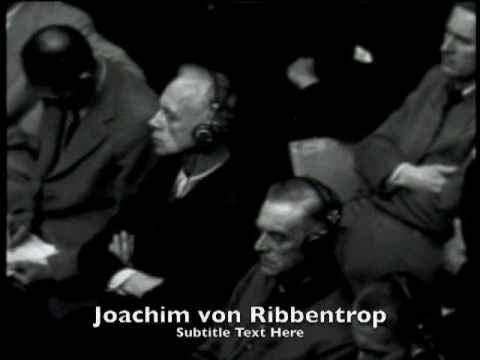
Oct 01, 1946 - Reading of The Judgment Against Franz von Papen
On Oct. 1, 1946, Franz von Papen, Vice Chancellor in the first Hitler Cabinet and Minister to vienna and Turkey, was acquitted on all four counts and freed.
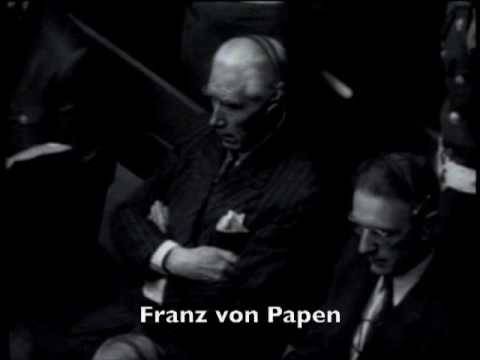
Oct 01, 1946 - Reading of The Judgment Against Fritz Sauckel
On Oct. 1, 1946, Fritz Sauckel, Gauleiter and Reichastatthalter in Thuringia and in 1942 Plenipotentiary for the Utilization of Labor, was found guilty on two counts and sentenced to death by hanging.

Oct 01, 1946 - Reading of The Judgment Against Alfred Rosenberg
On Oct. 1, 1946, Alfred Rosenberg, Reichsleiter and head of the Office of Foreign Affairs of NSDAP, was found guilty on all four counts and sentenced to death by hanging.

Oct 01, 1946 - Reading of The Judgment Against Arthur Seyss-Inquart
On Oct. 1, 1946, Arthur Seyss-Inquart, who held high positions in Austria, Poland and the Netherlands, was found guilty on three counts and sentenced to death by hanging.
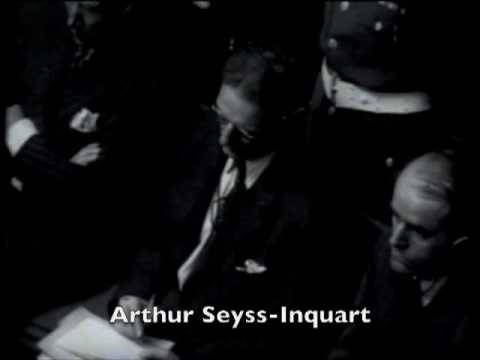
Oct 01, 1946 - Reading of The Judgment Against Wilhelm Frick
On Oct. 1, 1946, Wilhelm Frick, Reich Minister of the Interior from Jan. 1933-1943 and thereafter Reich Protector of Bohemia and Moravia, was found guilty on three counts and sentenced to death by hanging.

Oct 01, 1946 - Reading of The Judgments Against The Individual Defendants
On the morning of Oct. 1, 1946, the Tribunal read the Judgment on the guilt or innocence of the individual defendants. 19 were found guilty on one or more counts of the Indictment. Three were acquitted: Schacht, Fritzche and von Papen.
After lunch on Oct. 1, 1946, Chief Justice Lawrence announced the sentences to the Defendants that were found guilty. Death by hanging: Goering, Ribbentrop, Keitel, Jodl, Kaltenbruner, Streicher, Rosenbeg, Frank, Frick, Sauckel, Bormann and Seyss-Inquart. Life: Hess, Raeder and Funk. Twenty Years: Speer and von Schirach. Fifteen years: von Neurath. Ten Years: Doenitz.
